<?xml version="1.0" encoding="UTF-8"?>
<feed xmlns="http://www.w3.org/2005/Atom">
  <title type="text">The Mason Experience: Past and Present</title>
  <updated>2026-09-05T11:42:27+00:00</updated>
  <generator uri="http://framework.zend.com" version="1.12.20">Zend_Feed_Writer</generator>
  <link rel="alternate" type="text/html" href="https://pastandpresent.gmu.edu/"/>
  <link rel="self" type="application/atom+xml" href="https://pastandpresent.gmu.edu/items/browse?output=rss2"/>
  <id>https://pastandpresent.gmu.edu/</id>
  <author>
    <name>The Mason Experience: Past and Present</name>
    <uri>https://pastandpresent.gmu.edu</uri>
  </author>
  <link rel="hub" href="http://pubsubhubbub.appspot.com/"/>
  <entry>
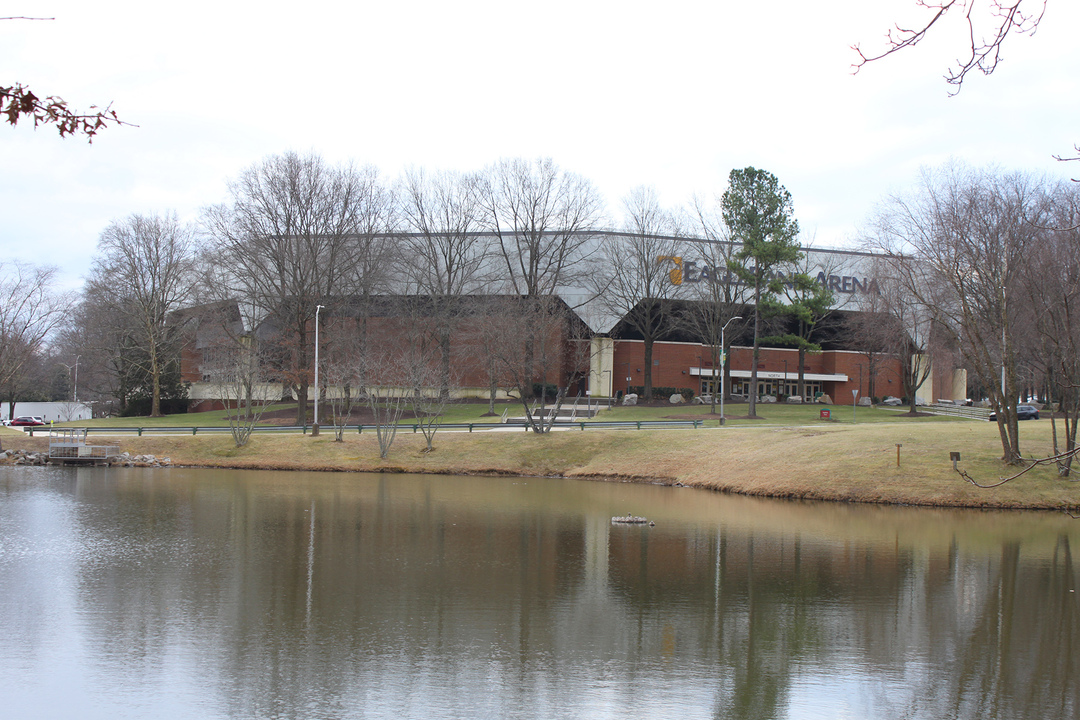
    <title type="html"><![CDATA[EagleBank Arena: Formerly known as Patriot Center]]></title>
    <summary type="html"><![CDATA[<p><strong><em>Completed in the fall of 1985, EagleBank Arena is one of Mason's most notable landmarks and top local venue for sports and entertainment. </em></strong></p><img src="https://pastandpresent.gmu.edu/files/fullsize/52d58490e38345a8e456267c66b701c8.jpg" alt="Eagle Bank Arena, view from the northwest" /><br/><p>On the south side of campus, nearly adjacent to Braddock Road is EagleBank Arena. Mason’s 10,000-seat venue has hosted sporting events, commencements, concerts, and other major gatherings since its completion in 1985. </p><p>Ten years after becoming independent in 1972, George Mason University grew rapidly. Enrollment had increased by nearly 500% (14,500 from about 3,000). Mason president George W. Johnson was determined to increase the university’s visibility in northern Virginia and encourage citizens to visit the campus. The PE Building, built in 1973, served as a sports arena and an auditorium for commencements, university celebrations, and other affairs, but its maximum capacity was 3,000. By 1982 the university was nearing the point where it was graduating almost 2,000 individuals each spring. It was clear a large multi-use building for university events was needed. </p><p>Construction began in August of 1983 with an expected opening of January 1985. University President, George W. Johnson planned to have Spring Commencement in the building, initially called “Patriot Center”. Previous ceremonies were held in the PE Building (today known as the RAC) and on various outdoor spaces around campus. As unexpected construction delays pushed the opening back toward fall of that year, Johnson remained undeterred in his desire to hold the event in THAT building THAT SPRING, declaring: “We will have graduation in the arena on May 18. You may have to wear a hard hat, but we are having it in there.”  </p><p>While graduating students had initially been told that their commencement would be held on the Quad in front of Fenwick Library, Johnson requested and received special permission from the building contractor to use Patriot Center, after passing necessary inspections, for the ceremony. Plywood was lain on the concrete floor and a temporary stage for the platform party was hastily set up. The concrete walls inside the arena, due to be painted in green and gold, remained unpainted and bare. Nevertheless, the ceremony went off without a hitch for the 2,204 graduates and their families on May 18. The arena was then re-closed to the public for completion of construction. </p><p>On October 4, 1985, the arena was open to the public for its first event; a capacity crowd, which included actor Jack Nicholson, saw a sold-out exhibition game between the New York Knicks and the Washington Bullets. The game featured then-rookie sensation and future Hall of Famer, Patrick Ewing. That fall Patriot Center became the permanent home of the Men’s and Women’s Basketball teams, ending twelve seasons in the PE Building. </p><p>On March 26, 2006, the Patriot Center was host to raucous victory celebration, as the Men’s Basketball team defeated the Number One Seed, University of Connecticut to earn a seat in the NCAA Final Four. As the game in the Verizon Center in Washington, DC ended, students formed a spontaneous victory parade around Patriot Circle and filled the Patriot Center to await the team’s return. As the team pulled into campus, fireworks were set off over Mason Pond. The team triumphantly marched into a Patriot Center full of happy students and members of the community.   </p><p>Since 1985, the building has hosted over 3,000 events and is among the top 100 grossing arenas in the world.  Beginning in 1998, EagleBank Arena's Parking Lot L has been host to the university's Mason Day event.</p><p>On May 7, 2015, the university announced that the name would be changed on July 1, 2015 to "EagleBank Arena at George Mason University" following a partnership deal with EagleBank.</p><p><em><strong><a href="https://pastandpresent.gmu.edu/items/show/9">For more (including 9 images) view the original article</a></strong></em></p>]]></summary>
    <published>2023-02-07T21:14:03+00:00</published>
    <updated>2026-04-17T19:45:23+00:00</updated>
    <link rel="alternate" type="text/html" href="https://pastandpresent.gmu.edu/items/show/9"/>
    <id>https://pastandpresent.gmu.edu/items/show/9</id>
    <author>
      <name>George Mason University Past and Present Team</name>
    </author>
  </entry>
  <entry>
    <title type="html"><![CDATA[Fenwick Library: Serving George Mason University Since 1967]]></title>
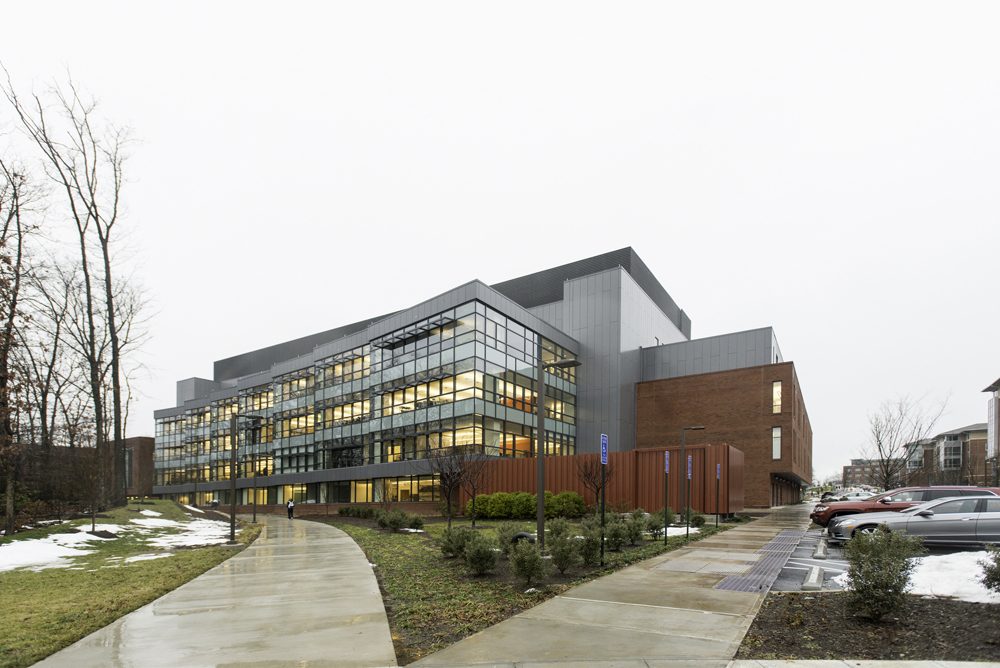
    <summary type="html"><![CDATA[<p><strong><em>Completed in October 1967 Fenwick Library has occupied the same spot for over 56 years. While it has undergone many changes over the years, its mission to facilitate access to scholarship and information and teach the effective and critical use of information remains the same. </em></strong></p><img src="https://pastandpresent.gmu.edu/files/fullsize/041022fd2a911150eb2fd26684361054.jpg" alt="Fenwick Library, view from the southeast" /><br/><p>George Mason University Libraries began operation in September 1957 at Bailey's Crossroads Campus, occupying three of the four rooms on the upper level of the building. As the number of library resources increased, librarians, who moonlighted at Bailey's while employed at other local libraries, stored newly acquired resources in closets and bookcases sitting in hallways.  </p><p>When the college moved into the new campus at Fairfax in 1964, a permanent college librarian was hired by the University. Patrick Joseph Larkin, a recent graduate of the Master of Library Science at nearby Catholic University was chosen to head up the new Library. Initially, the Library was located on the 2nd Floor of the new Fairfax Campus' East Building.  During this time planning for Mason’s permanent stand-alone library at Fairfax was gearing up with Larkin and officials from George Mason College and the University of Virginia actively participating in the design and functionality groundwork. </p><p>Mason's permanent Library was designed for a “commuter college” with specific needs: a large commuting student body, an evolving program of studies, and a rapid growth rate.  Mason had less than 1,000 students during the late-1960s, but more than twice that many after only five years. In 1966 a report of the Northern Virginia Regional Planning and Economic Development Council estimated that by 1985, 15,000 high school graduates would be knocking on Mason’s doors. </p><p>The architectural firm Vosbeck-Vosbeck & Associates of Alexandria designed a two-story white concrete-columned structure with alternating brick panels. The building contained 31,500 square feet, housed up to 60,000 book volumes, and seated almost 500 readers.  Construction began in July 1966 at a cost of $1.2 million (a little more than $10 million in 2023).          </p><p>The library took about fifteen months to complete. By the third week in October 1967, it was ready for use. On move-in day library staff, along with dozens of volunteers from the student body, carted some twenty thousand volumes from the East Building to the new library to be shelved.  The building was formally dedicated on December 15, 1967, in an hour-long ceremony which was concluded with an announcement that it would be named Fenwick Library, after State Senator Charles Rogers Fenwick, a longtime political ally of George Mason College. </p><p>By 1974 enrollment at George Mason, now a university, had increased by more than 500% since 1967. Library space expanded to keep up with the demands of a growing university.  This came in the form of two adjoining towers, one completed in 1974, and the other in 1983. The towers now known as Wings B and C increased the library’s storage space by twelve times. During the late 1980s there were plans to increase library space once again, but these plans were scrapped to design and build the facility now known as the Johnson Center.  Beginning in the 1980s, the stage for Mason Day band performances was placed on the plaza in front of the Fenwick Library entrance and for nearly twenty years, the sounds of live music would permeate the library on that day. </p><p>Beginning in September 2012 Fenwick Library underwent a four-year transformation to bring it up to par with other major university libraries in the commonwealth. This addition, which opened in 2016, wrapped the existing Wing B and C towers and doubled the library’s space, enabling the university to meet growing needs for a variety of study and research spaces.</p><p><em><strong><a href="https://pastandpresent.gmu.edu/items/show/5">For more (including 7 images) view the original article</a></strong></em></p>]]></summary>
    <published>2022-10-20T20:48:43+00:00</published>
    <updated>2026-04-17T19:45:23+00:00</updated>
    <link rel="alternate" type="text/html" href="https://pastandpresent.gmu.edu/items/show/5"/>
    <id>https://pastandpresent.gmu.edu/items/show/5</id>
    <author>
      <name>George Mason University Past and Present Team</name>
    </author>
  </entry>
  <entry>
    <title type="html"><![CDATA[The First Four Buildings at the Fairfax Campus: North, South,  East and West Buildings]]></title>
    <summary type="html"><![CDATA[<p><strong><em>The Fairfax campus opened in September 1964 with only four buildings. From then until 1974, these original buildings were the center of Mason student life and the site of many notable events.</em></strong></p><img src="https://pastandpresent.gmu.edu/files/fullsize/1b10b4e17a34adc477b0062f706460b4.jpg" alt="George Mason College, Fairfax Campus, ca. 1965, aerial photograph" /><br/><p>A groundbreaking ceremony for the new Fairfax campus was held on August 1, 1963. Students at Bailey’s Crossroads knew of the construction, but few were interested in following it. Student photographers Jim Wilson and Bill Flandermeyer visited the campus while it was under construction and took some of the earliest photographs of the Fairfax campus.
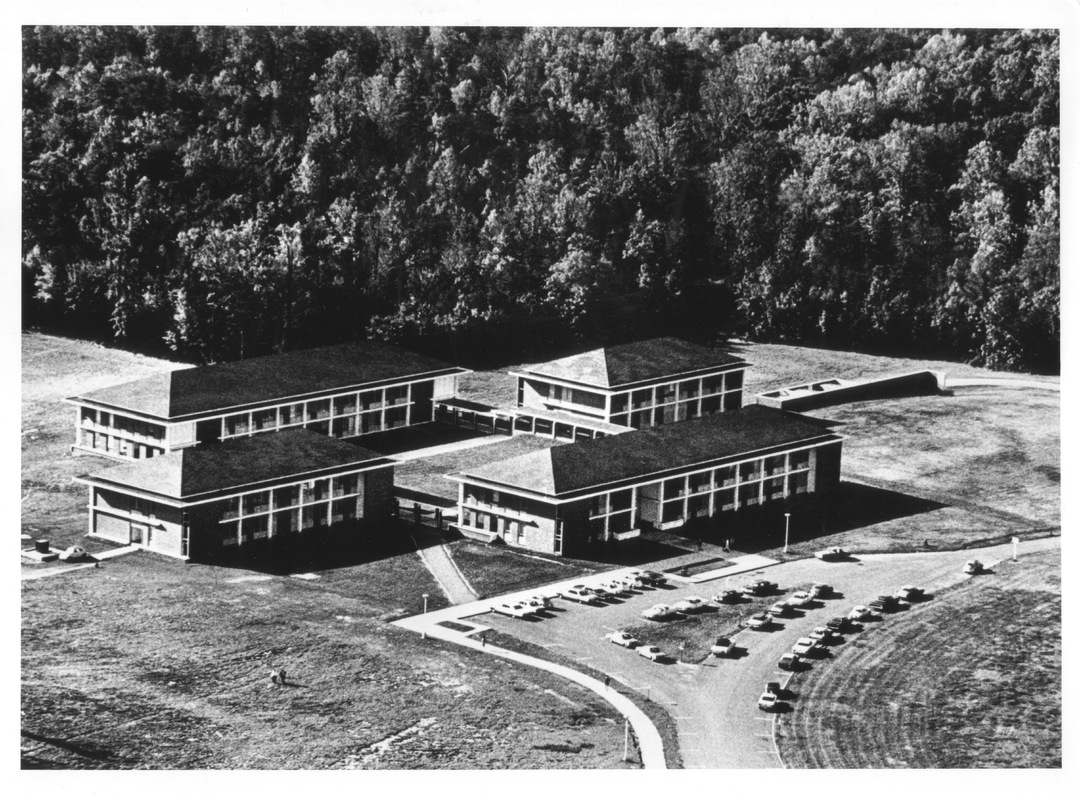
The campus at Fairfax officially opened on Monday, September 14, 1964, to 356 registered students. This number represented a 58% increase in the student population from the final school year at Bailey’s Crossroads. The original campus consisted of four buildings, named North, South, East and West, each for the direction it faced. Because the campus was initially small, students spent much of their campus life from 1964 to 1974 in these first four buildings. The then-state-of-the-art buildings were designed and built by local businesses Joseph Saunders & Associates of Alexandria and Eugene Simpson and brother, respectively.  
On opening day, Mason’s new director, Robert Reid, boasted to the Fairfax Times that Mason was the first fully air-conditioned college in the Washington, D.C., area. Air conditioning was a welcome change for students and faculty who experienced the lack of climate control in the old school building at Bailey’s Crossroads. They were delighted with the spacious, top-of-line classrooms and laboratories. The air conditioning and brand-new facilities temporarily distracted them from realizing the campus lacked some essential amenities. During the first week, there was no faculty lounge or place for students to get food and beverages. Mason’s administration quickly set up vending machines in a study hall as a temporary solution.
The campus was formally dedicated on November 12, 1964. The ninety-minute dedication ceremony took place in front of the North Building. Nearly a thousand people attended, including prominent politicians, educators, members of the community and the local press.
Construction was still ongoing when the Fairfax campus opened. The sidewalks were incomplete, so planks were put down when it rained. The covered walkways between the buildings had yet to be constructed. Former students described the campus as “a sea of mud.” Even with the wooden planks, mud was difficult to avoid since students had to cross an unpaved path between the North and East Buildings to reach their gravel parking lot. Photographs from the 1965 to 1966 yearbook show that in addition to the completion of sidewalks and covered walkways, the roads around campus and parking spaces were paved, finally ending the mud problem.</p><p><strong>South Building (Krug Hall)</strong>
By 1965, the students received a dining hall in the basement of the South Building. They named it the Ordinary, after the old English word for a pub. Chemical smells often drifted in from the biology and chemistry laboratories directly above. The Ordinary quickly became a popular hangout spot for students. Like their predecessors at the Bailey’s Crossroads campus, alumni from the Class of 1968 recalled playing competitive games of Hearts, Spades and Bridge. These card games were sometimes so intense that students nearly missed classes.
The Ordinary started serving fresh food in the fall of 1965. Articles <em>in The Gunston Ledger</em> frequently complained that the Ordinary was too crowded, so additional spaces for students to gather were added or improved in the East and West Buildings beginning in 1965. The Ordinary featured a jukebox. When the original jukebox died in April of 1966, a student penned an obituary for it in <em>The Gunston Ledger </em>commemorating its year and a half of service to students. <em>The Gunston Ledger</em> gleefully announced the purchase of a new jukebox for the Ordinary in October 1966. The Ordinary remained a gathering place for students until 1974 when the building that is now SUB I was completed.
Mason Day began in 1965 as a half-day of speeches and awards the day after UVA's Founder's Day celebration. During the 1968 to 1969 school year, Student Government Activities Chair, Mike Baker, transformed Mason Day into a multi-day spectacle of fun and entertainment. As part of Mason Day in 1969, for 3 days, 40 male students camped in tents behind the South Building. The event was labeled “Mason’s First Dormitories.” They ate their meals in the Ordinary, played sports on the lawn, roasted hot dogs, played music, watched movies and attended a presentation by local photographer Charles Baptie in the Lecture Hall, and staged a water balloon fight. Mason Tent City remained a tradition until 1977, when the university opened permanent dormitories.</p><p><strong>North Building (Finley Building)</strong>
The North Building originally housed Mason’s administrative offices. An anonymous article in <em>The Gunston Ledger</em>, on November 16, 1967, decried that Mason was the only institution in Virginia without a flagpole. The writer implored students to find a way to raise $150 for a flagpole. The shaming worked, and a flagpole, which no longer stands, was installed in front of the North Building shortly after.
According to <em>Broadside</em>, beginning November 10, 1969, students stood in front of the flagpole in a memorial vigil of the lives lost in the Vietnam War. The previous month, the Vietnam War Moratorium Committee had presented Chancellor Lorin Thompson with a petition containing hundreds of signatures from students and faculty asking to be excused for one day of classes to participate in anti-war activities. Thompson rejected their petition. The vigils in front of the flagpole, visible from the administrative offices, were likely a response to his denial of their request.
The Vietnam War Moratorium Committee had officially scheduled to attend an off-campus event on November 14, 1969. So students were shocked when a group of protestors, in a spectacle <em>Broadside</em> called "Guerrilla Theatre", burned an American flag in the Ordinary. That same afternoon, Professor James Shea led students in burning draft cards in the Quadrangle. The Guerrilla Theatre incident divided the Vietnam War Moratorium Committee's student leaders, with Jim Corrigan speaking out against it and George Whelpley behind it. The Student Government was similarly divided, voting 6-3-3 to oppose disciplinary action against those responsible for the incidents. The Student Government supported Shea and asked the administration to retain him.
On the morning of May 6, 1970, Mason students asked Thompson to lower the flag in honor of students killed by the National Guard at Kent State University two days earlier. Thompson denied their request. A Kent State student spoke in the Quadrangle. Following the speech, a demonstration of fifty Mason students marched to the flagpole in an attempt to lower the flag by cutting the cord used to raise and lower it. Campus police confronted the demonstrating students. At noon, Thompson agreed to lower the flag to half-mast to accommodate the students and prevent any unrest.</p><p><strong>East Building</strong>
The second floor of the East Building served as Mason's library until its free standing library was completed in late 1967. The entire East Building had originally been allotted for the library. However, the librarian generously gave two floors back to the college, which they used for classrooms and an additional lounge. In 1965, SAGE, a women’s organization on campus, hosted a fashion show in the East Building. On June 9, 1965, the first final day exercises were held in the East Building, and Mason’s class of 1965 received their diplomas. In 1968, the first class to graduate with Bachelor’s degrees from Mason put on their graduation robes in Eats before proceeding to the ceremony in the Lecture Hall.</p><p><strong>West Building</strong>
The West Building became the center of attention at Mason on September 21, 1966. At 2:10 pm that day, a hot water pump motor in the boiler room burned out and caused an electrical fire. The building’s supervisor discovered it but found his telephone was out of order. He then drove to the Fairfax Fire Station to report to the fire alarm. Seven fire trucks from Fairfax, Vienna, and Annandale responded to the fire alarm. The fire marshal ordered everyone to evacuate the smoke-filled West Building upon arrival. Firefighters set up fans to blow the smoke out of the building. Once it cleared, they put out the fire with a regular fire extinguisher. No one was injured, but students and staff were inconvenienced because the fire knocked out all telephone service and many of the lights across campus. The food machines in the Ordinary also did not work. Classes were dismissed for the rest of the day.</p><p><em><strong><a href="https://pastandpresent.gmu.edu/items/show/4">For more (including 13 images, 1 audio file,&#32;&amp;&#32;1 video) view the original article</a></strong></em></p>]]></summary>
    <published>2022-10-18T20:04:57+00:00</published>
    <updated>2026-04-17T19:45:23+00:00</updated>
    <link rel="alternate" type="text/html" href="https://pastandpresent.gmu.edu/items/show/4"/>
    <id>https://pastandpresent.gmu.edu/items/show/4</id>
    <author>
      <name>George Mason University Past and Present Team</name>
    </author>
  </entry>
</feed>