<?xml version="1.0" encoding="UTF-8"?>
<feed xmlns="http://www.w3.org/2005/Atom">
  <title type="text">The Mason Experience: Past and Present</title>
  <updated>2026-09-05T00:13:00+00:00</updated>
  <generator uri="http://framework.zend.com" version="1.12.20">Zend_Feed_Writer</generator>
  <link rel="alternate" type="text/html" href="https://pastandpresent.gmu.edu/"/>
  <link rel="self" type="application/atom+xml" href="https://pastandpresent.gmu.edu/items/browse?output=rss2"/>
  <id>https://pastandpresent.gmu.edu/</id>
  <author>
    <name>The Mason Experience: Past and Present</name>
    <uri>https://pastandpresent.gmu.edu</uri>
  </author>
  <link rel="hub" href="http://pubsubhubbub.appspot.com/"/>
  <entry>
    <title type="html"><![CDATA[The Jimmy and Rosalynn Carter School for Peace and Conflict Resolution : Evolving in the Field of Peace Studies for Over Forty Years]]></title>
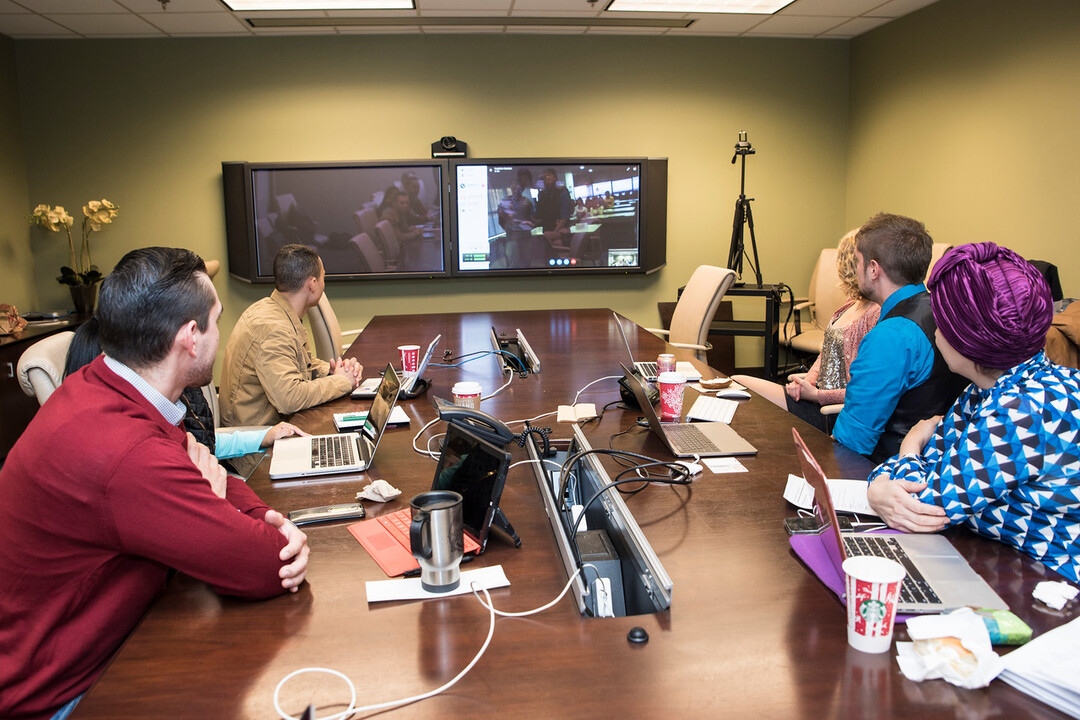
    <summary type="html"><![CDATA[<p><strong><em>The Jimmy and Rosalynn Carter School for Peace and Conflict Resolution  has been evolving for over forty years. Still its mission to develop professionals who can identify sources of conflict and create peaceful change in those situations has not changed.  </em></strong></p><img src="https://pastandpresent.gmu.edu/files/fullsize/10b8e387bb7e8c2d5f707bed6f5ba909.jpg" alt="Carter School students participate in a videoconference" /><br/><p>The Jimmy and Rosalynn Carter School for Peace and Conflict Resolution (The Carter School) has been evolving and growing ever since its inception in 1981. Its name has changed several times—it has been known as the Center for Conflict Resolution, the Center for the Analysis and Resolution of Conflict, the Center for Conflict Analysis and Resolution, the Institute for Conflict Analysis and Resolution (ICAR), the School for Conflict Analysis and Resolution (SCAR), and, finally, the Carter School. Originally a small unit housed in a module, another word for a temporary building, on the Fairfax Campus, the Carter School is now an integral part of the Mason Square Campus, home to the university's most high-visibility programs.
In 1981 Mason established Mason's Center for Conflict Resolution under professors Bryant Wedge and Henry Barringer. The idea for the program stemmed from earlier proposals in the 1970s to establish a United States Academy of Peace. Dr. Wedge, a social psychiatrist, was the Center’s first director. Wedge believed that conflict is an inevitable part of the human condition, and that conflict itself can be managed. Unmanaged conflict can lead to war, and war should be avoided at all costs. These ideas informed the Center's original mission statement. While Wedge and Barringer’s offices were in Fenwick Library, the Center was housed in the Humanities Module which stood in the spot now occupied by today's Johnson Learning Center. By 1983 the Center would call the former Robinson Hall its home. 
The Center focused on four distinct activities—research, instruction, clinical service, and outreach. An on-campus dispute resolution service, the Conflict Clinic, Inc., operated in the Center's office in the Humanities Module. By 1987 the faculty included esteemed and well-published professors Dr. Dennis J. Sandole, Dr. James H. Laue, a civil rights activist and associate of Dr. Martin Luther King, Jr.; Dr. John W. Burton, a former Australian diplomat and pioneer in conflict resolution; Dr. Joseph Scimecca, the Center’s second director; and Professor Richard Rubenstein, his successor. </p><p>Dr. Burton was instrumental in reshaping shaping the Center’s focus and its future. He theorized that successful resolution of conflict required an understanding of basic human needs, such as self-actualization, esteem, freedom, and justice. Burton suggested that the Center focus research on long-term conflict resolution instead of temporary settlement of disputes.  By 1982 the program offered an MS in Conflict Management and in 1987, a Ph.D. in Conflict Analysis and Resolution. These were the first degrees of their kind in the United States.
From 1988 to 1990 program enrollment and faculty numbers increased and, in 1991, the Center became the Institute for Conflict Analysis and Resolution (ICAR). The Institute moved to a series of leased offices on Chain Bridge Road about a quarter of a mile north of the university. In July 2001, ICAR became the School of Conflict Analysis and Resolution (S-CAR), the first of its kind in the world. The September 11, 2001, terrorist attacks dramatically increased interest in conflict analysis and resolution. As a result, ICAR experienced a 35% increase in enrollment applications in 2002. ICAR soon outgrew its Fairfax home and moved to Arlington in the fall of 2004. </p><p>In 2016 Mason opened the Point of View Conference and Retreat Center on over one hundred acres on Fairfax County’s Mason Neck donated by long-time Mason benefactors Edwin and Helen Lynch. The facility's main purpose is to host peace building conferences and negotiations. In 2020, the school was renamed the Jimmy and Rosalynn Carter School for Peace and Conflict Resolution to honor the Carters' lifetime of dedication to peaceful conflict resolution.</p><p><em><strong><a href="https://pastandpresent.gmu.edu/items/show/23">For more (including 3 images) view the original article</a></strong></em></p>]]></summary>
    <published>2023-07-03T19:53:12+00:00</published>
    <updated>2026-04-17T19:45:24+00:00</updated>
    <link rel="alternate" type="text/html" href="https://pastandpresent.gmu.edu/items/show/23"/>
    <id>https://pastandpresent.gmu.edu/items/show/23</id>
    <author>
      <name>George Mason University Past and Present Team</name>
    </author>
  </entry>
  <entry>
    <title type="html"><![CDATA[The Schar School of Government and Policy: Educating Tomorrow&#039;s Leaders ]]></title>
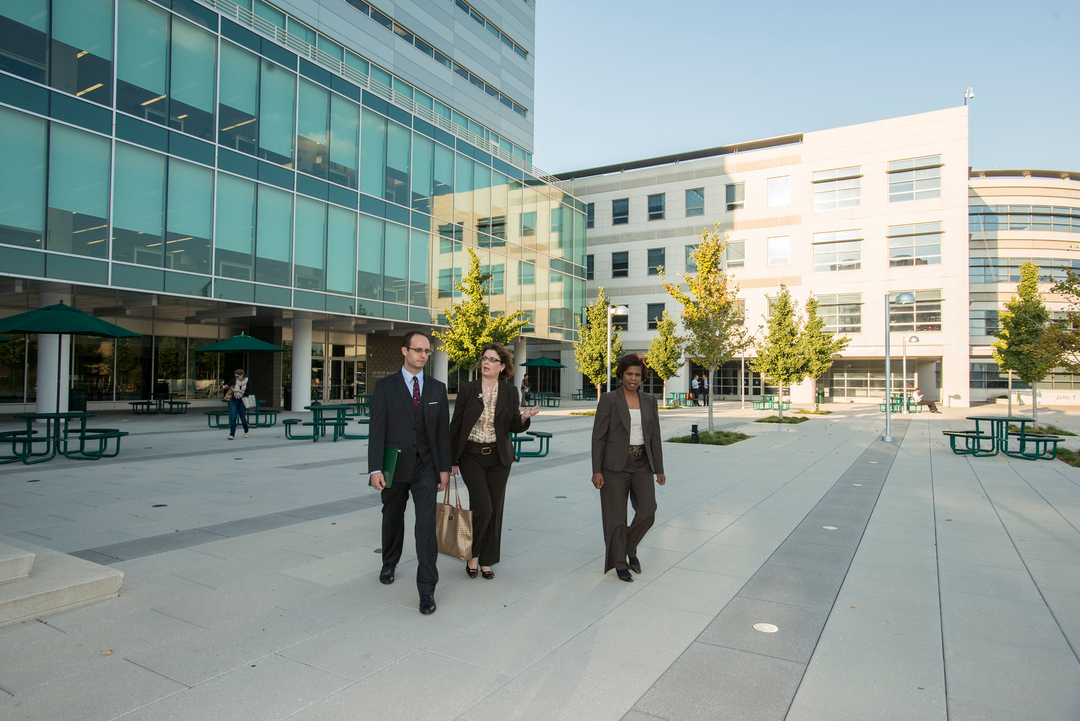
    <summary type="html"><![CDATA[<p><strong><em>The predecessor to the Schar School of Policy and Government, TIPP, was originally envisioned as a "think tank" staffed with faculty from multiple disciplines across the university to research policy issues.  Today, Schar helps undergraduate, graduate, and doctoral students navigate the complexities of policymaking and public administration.  </em></strong></p><img src="https://pastandpresent.gmu.edu/files/fullsize/93f70282c9f7dd18113cca8ba2f9111c.jpg" alt="Schar students on the Mason Square Campus " /><br/><p>Mason’s Schar School of Policy and Government began on the Fairfax Campus and later moved to Mason Square Campus in the early 2000’s. Today’s Schar School came about as a result of a merger of two Mason academic units, The School of Public Policy (SPP) and the former College of Arts and Sciences (CAS)’ Department of Public and International Affairs, each established in 1990. The two combined in 2014, forming one school with the mission of training undergraduate, graduate, and doctoral students to be leaders in government, policymaking, consulting, and analysis in the public sphere. </p><p>SPP began as The Institute for Public Policy (TIPP), established by former George Mason Graduate School Dean, Kingsley E. Haynes in 1990. Initially founded as a research institute for the study of policy issues, TIPP began serving the university in an older temporary building called the Pohick Module. In 1992, a Ph.D. program was established, and by 1994, TIPP created an interdisciplinary master’s degree in Economic Development and Technology in partnership with the Schools of Business Administration and Information Technology and Engineering. TIPP also developed programs with the Institute for Conflict Analysis and Resolution and CAS’ Economics, Public and International Affairs, and Communication departments. These partnerships showed TIPP’s commitment to going beyond the ordinary boundaries of a discipline to address the wide variety of policy concerns, such as public policy management, science and technology policy, health policy, and human resource policy. </p><p>TIPP incorporated economics, public administration, business, law, information technology, and the liberal arts, as well as uniquely American ideas, practices, and traditions into its curriculum. The program insisted that future American leaders will need a firm grounding in history, ethics, and world culture if they are to deal successfully with important national issues, such as budget, trade, and employment. </p><p>Over the next several years, TIPP partnered with the federal government and universities from around the world, particularly in South America and Asia, generating research funding in the defense, information technology, and e-commerce sectors. In 2000 TIPP became Mason’s School of Public Policy (SPP) and moved to the Finley Building. In SPP 2010 moved from Fairfax to the then-named Arlington Campus and housed in Arlington Original, the former Kann’s department store. </p><p>In 2014, the SPP and the College of Humanities and Social Sciences’ Department of Public and International Affairs merged, creating the School of Policy, Government, and International Affairs, offering comprehensive graduate and undergraduate education in public policy, public administration, international affairs, and political science. In 2016, the school was renamed the Schar School of Policy and Government following a $10 million donation from businessman and philanthropist Dwight Schar. </p><p>In addition to its academic offerings, in 2016 the Schar School began a partnership with the <em>Washington Post</em> to conduct polling in Virginia and nationwide. Today, <em>Washington Post/</em> Schar School polling gives readers insight on issues ranging from national politics to local business and economics.</p><p><em><strong><a href="https://pastandpresent.gmu.edu/items/show/22">For more (including 4 images) view the original article</a></strong></em></p>]]></summary>
    <published>2023-07-03T18:45:42+00:00</published>
    <updated>2026-04-17T19:45:24+00:00</updated>
    <link rel="alternate" type="text/html" href="https://pastandpresent.gmu.edu/items/show/22"/>
    <id>https://pastandpresent.gmu.edu/items/show/22</id>
    <author>
      <name>George Mason University Past and Present Team</name>
    </author>
  </entry>
  <entry>
    <title type="html"><![CDATA[The Founding of the Antonin Scalia Law School : The Program That Launched Mason Square Campus ]]></title>
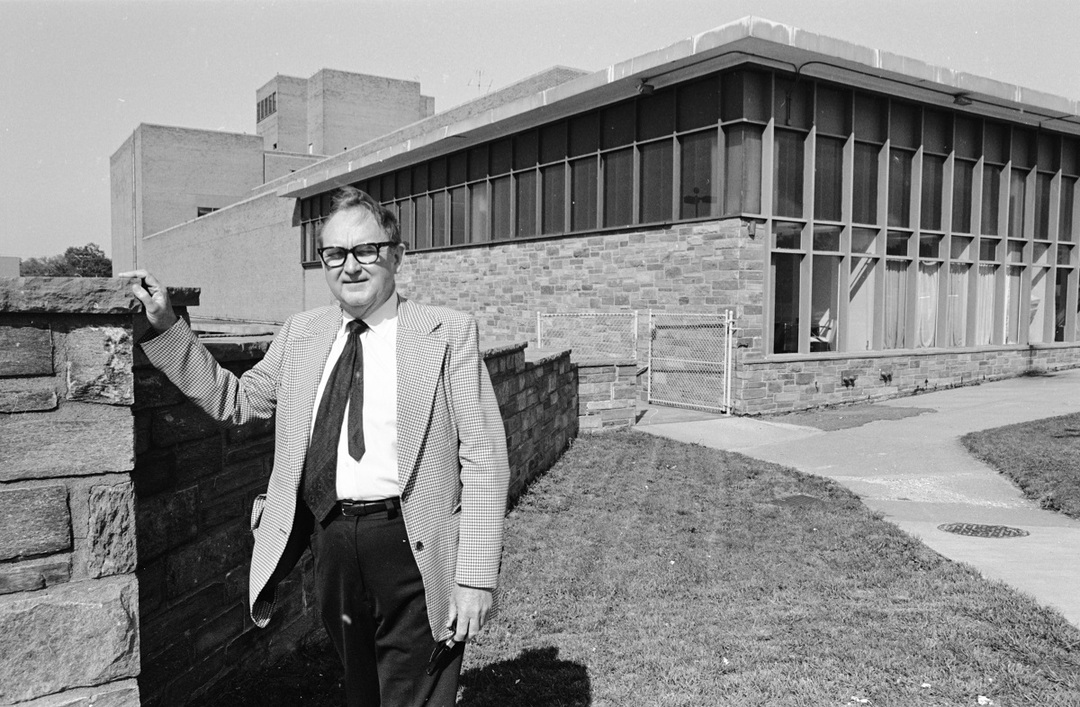
    <summary type="html"><![CDATA[<p><strong><em>Mason's Antonin Scalia Law School has it roots in the 1979 merger between George Mason University and a small struggling private law school, the International School of Law.  </em></strong></p><img src="https://pastandpresent.gmu.edu/files/fullsize/f4fe4fc9d6d6ad29ad549e0a3e0ee377.jpg" alt="George Mason University School of Law Dean, Ralph N. Norvell, in front of the School of Law building" /><br/><p>The George Mason University School of Law, today known as Antonin Scalia Law School, became Mason’s first program in Arlington in 1979 after the Virginia Senate and House of Delegates passed Senate Bill 607, authorizing <a href="https://masonlibraries.org/masonhistory/exhibits/show/prominence/schooloflaw">the merger between George Mason University and the International School of L<span>aw</span>.</a> </p><p>The <a href="https://masonlibraries.org/masonhistory/exhibits/show/prominence/isl">International School of Law (ISL)</a> <span>was founded in 1972 by a group of attorneys led by John Brabner-Smith, who became its first dean. In addition to Brabner-Smith, the ISL’s founding attorneys included James L. Fisk, Phil W. Jordan, George L. Powell and Daniel D. Smith.</span>
<span>Brabner-Smith was part of the Illinois State Attorney’s prosecution team whose work helped bring down the notorious gangster, Al Capone. He then worked for the federal government before switching to private practice in Washington, DC. During World War II, he served as Chief of the Legal Division of the Army Provost Marshall General's office. After World War II, he served on the German Allied Control Council and lectured throughout Germany about constitutional governments. There, he met his future wife, Daniela Siemens. The couple married during the Berlin Airlift in 1948 and settled in Washington, DC. </p><p>In 1972, Daniela Brabner-Smith met University of Virginia Law School graduate and Marine Corps veteran Daniel D. Smith at a conference. They became friends, and she invited him and his wife to visit. During the Smith's visit, Brabner-Smith explained his plan to start a law school emphasizing morals and ethics. He invited Smith to join the ISL’s group of founders, who also financed the law school’s operations. Smith initially declined before accepting a few months later and becoming Administrative Dean. </span>
<span>Smith, Powell, and their wives recruited the ISL’s first students by visiting the admissions office of the George Washington University Law School, obtaining the addresses of rejected applicants, and sending each one a mimeographed letter inviting them to apply for the ISL. Their efforts resulted in the ISL’s inaugural class of 32 students, who received instruction from part-time faculty. The following year, the ISL grew and moved to spaces on Rhode Island Avenue, which the faculty and students renovated themselves. </span>
<span>However, despite efforts by the students and faculty to grow and improve the school, the American Bar Association (ABA) denied the ISL’s accreditation, making it nearly impossible for its graduates to practice law. The ISL applied for ABA accreditation a second time after adding several full-time faculty. However, right before their ABA review appointment, Brabner-Smith withdrew the application without consulting the ISL’s board members. As a result, the board terminated Brabner-Smith in 1975 and hired Ralph Norvell as Dean later that year. In 1977, the ISL purchased and moved into the former Kann’s department store building in the Virginia Square section of Arlington. Despite improvements to its space and faculty, the ISL was again denied ABA accreditation because it was a freestanding law school without an association to an accredited university. </span>
<span>The ISL would need to merge with a university to continue, and George Mason University wanted to add a law school as part of its offerings. Norvell and George Mason University Board of Visitors Rector, Til Hazel, himself a Harvard Law alum, agreed to work together. </span>To ensure the merger would succeed, Hazel created the “Urge to Merge” lobbying campaign to convince Virginia’s General Assembly to give their approval. </p><p>Law school students were motivated by the prospect of accredited degrees and a chance to sit for the bar exam, so they collaborated with Hazel on the campaign and were instrumental in its success. They traveled to Richmond and lobbied the General Assembly to approve the merger. Hazel said regarding the “Urge to Merge” campaign, “I was down there lobbying every way I knew how, but the real lobbyists, the effective ones, were the law students.” Both the House of Delegates and the Senate approved the merger by wide margins in early February 1979. 
Officially opening on July 1, 1979, the newly established George Mason University School of Law held its first commencement in August of 1980, graduating 265 and received full ABA accreditation in 1986. In 2016, the law school was renamed Antonin Scalia Law School, after the late Supreme Court Justice. Today the Antonin Scalia Law School enrolls just over six hundred students. </p><p><em><strong><a href="https://pastandpresent.gmu.edu/items/show/21">For more (including 5 images&#32;&amp;&#32;2 videos) view the original article</a></strong></em></p>]]></summary>
    <published>2023-05-11T15:11:46+00:00</published>
    <updated>2026-04-17T19:45:24+00:00</updated>
    <link rel="alternate" type="text/html" href="https://pastandpresent.gmu.edu/items/show/21"/>
    <id>https://pastandpresent.gmu.edu/items/show/21</id>
    <author>
      <name>George Mason University Past and Present Team</name>
    </author>
  </entry>
  <entry>
    <title type="html"><![CDATA[Mason Square: The Arlington Campus]]></title>
    <summary type="html"><![CDATA[<p><strong><em>Mason’s Arlington campus, Mason Square, came to be through of the resolution of two distinct challenges: the university’s desire to have a law school, and a small local law school’s difficulties in attaining accreditation. </em></strong></p><img src="https://pastandpresent.gmu.edu/files/fullsize/16b7d5caec5f888a7a6ef2e77d6a1d61.jpg" alt="The Arlington Campus" /><br/><p>In 1978, the George Mason University Foundation purchased eleven acres of land and the former Kann’s department store building in the Virginia Square neighborhood in Arlington. After Kann’s closed in 1975, the <a href="https://masonlibraries.org/masonhistory/exhibits/show/prominence/isl">International School of Law (ISL)</a> purchased the building in anticipation that the area’s projected growth would attract more students. However, the reality was that for ISL to stay open, they needed American Bar Association accreditation, which remained elusive.
Coincidentally, George Mason University wanted a law school and believed the Northern Virginia region needed one. Unfortunately, the Association of American Law Schools, the State Council of Higher Education for Virginia (SCHEV) and the General Assembly rejected Mason's request to establish a law school, twice. In 1976, the Honorable Charles S. Russell, a judge for the Seventeenth Judicial Circuit and, later, the Supreme Court of Virginia, became aware that Mason’s Board of Visitors hoped to add a law school to grow the university. Russell knew that ISL and Mason were seeking partnerships to resolve their respective law school difficulties. So, Russell arranged a secret meeting between ISL Dean, Ralph Norvell and the Rector of Mason’s Board of Visitors, John “Til” Hazel, at a restaurant across the street from ISL. As they ate lunch, the two men agreed that a merger would be advantageous to each of their respective institutions. Hazel and Norvell shook hands and decided to work together for Mason’s and ISL’s mutual benefit. But first, they needed both SCHEV and the General Assembly to approve the merger.
Unfortunately, Mason and ISL also faced opposition to their merger. In November 1978, Mason purchased ISL’s property in Arlington for $3.2 million. In response to this gutsy move, SCHEV issued an additional report to the General Assembly, again showing resistance to the merger. To ensure Mason’s attempt to acquire a law school would succeed, Hazel created the “Urge to Merge” lobbying campaign to convince Virginia’s legislature to approve the merger. Motivated by the prospect of accredited degrees and a chance to sit for the bar exam, law school students worked with Hazel on the campaign. Their efforts were rewarded in February 1979 when the State Senate and House of Delegates passed Senate Bill 607, authorizing <a href="https://masonlibraries.org/masonhistory/exhibits/show/prominence/schooloflaw">the merger between George Mason University and ISL</a>. Mason finally had a law school, and ISL students received accredited degrees that spring.
The former department store building, built in 1953, became Mason’s first building on the new Metro Campus, its name before it was renamed <a href="https://masonlibraries.org/masonhistory/exhibits/show/prominence/arlington">Arlington Campus</a> in 1989. The building was known as "Original" or "Arlington Original". The building had escalators and a PA system from its time as a department store, making it the only law school building with an escalator at the time of the merger. Law school students recalled using the PA system to request assistance from facilities staff. Original's huge footprint allowed Mason to expand its programs, eventually filling up the law school building. As Mason’s enrollment in Arlington increased, the university leased space in neighboring buildings, such as one at Quincy Street Station, eight blocks to the south. However, this solution could still not sustain Mason’s rapid growth in Arlington.
By 1988, GMU President George Johnson had plans to grow the Arlington Campus and make the Virginia Square neighborhood “an educating community.” As a result, Mason drafted expansion plans that included multiple phases of construction. The first phase provided a modern building, Arlington I, for the law school and its library on the land that used to be Original’s parking lot. Arlington I’s construction broke ground on April 25, 1996, and cost approximately $19 million. This new building opened in 1998 and dedicated in January 1999. Arlington I became the new home of the law school, its library, the Mercatus Center and the Institute for Humane Studies. As a result, programs in the leased Quincy Street Station location moved into Original. The second expansion on the Arlington campus was completed shortly afterward. It included a 240,000-square-foot building and public plaza between Arlington I and Original. This building housed a library, an art gallery, and a large auditorium. The Metropolitan Building, located between the Law School and FDIC headquarters, opened in 2006 and houses a parking garage and office space. Construction on Arlington II finished in 2011. This building became home to the then-named School of Public Policy and was known as Founders Hall.
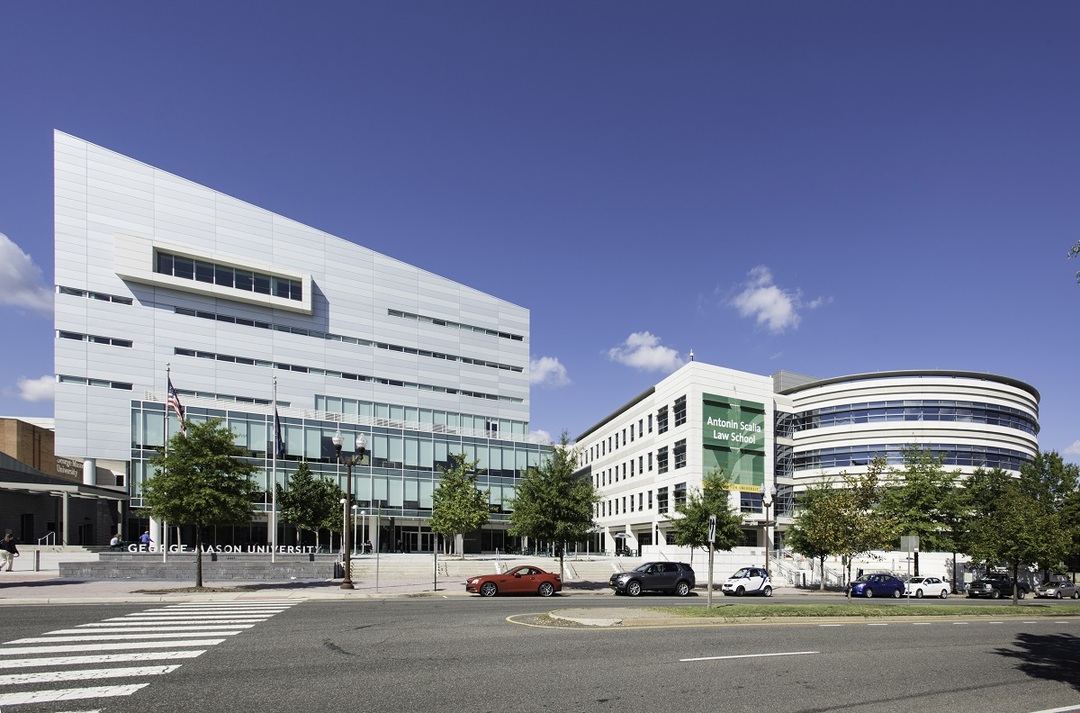
In 2005, Arlington I was renamed John T. Hazel, Jr. Hall (Hazel Hall) in recognition of the role Rector Hazel played in establishing Mason’s law school. Hazel Hall is home to Antonin Scalia Law School, renamed after the late Supreme Court Justice in 2016. In June 2017, the Foundation Building was renamed Vernon Smith Hall in honor of Mason’s second Nobel Prize winner. Vernon Smith Hall is home to the Jimmy and Rosalynn Carter School for Peace and Conflict Resolution. Founders Hall was renamed Van Metre Hall in October 2018 in recognition of a previous donation of land by Van Metre Companies, a local commercial and residential real estate firm. Van Metre Hall is home to the Schar School of Policy and Government, named for benefactor, Dwight Schar. Finally, in 2020, Original was demolished to make way for a new building, Fuse, which will focus on technological innovation and entrepreneurship.
The Arlington Campus became known as Mason Square in 2022. Mason Square predominantly offers evening classes, and the campus comes alive around 4 p.m. Its plaza has become an energetic center for campus and community engagement. It has featured a game cart, a ping pong table, and a cornhole set for use by the local community. Free yoga classes and juggling lessons have been offered in the plaza, and musicians play cheerful music in the plaza regularly. The plaza also hosts outdoor concerts and movie screenings. Mason Square is located across the street from the original El Pollo Rico restaurant, a beloved hangout spot. In addition, Mason Exhibitions Arlington is two blocks from the campus on Fairfax Drive. Construction on Fuse is expected to be completed in 2025.
 </p><p><em><strong><a href="https://pastandpresent.gmu.edu/items/show/20">For more (including 8 images&#32;&amp;&#32;1 video) view the original article</a></strong></em></p>]]></summary>
    <published>2023-05-01T19:07:41+00:00</published>
    <updated>2026-04-17T19:45:24+00:00</updated>
    <link rel="alternate" type="text/html" href="https://pastandpresent.gmu.edu/items/show/20"/>
    <id>https://pastandpresent.gmu.edu/items/show/20</id>
    <author>
      <name>George Mason University Past and Present Team</name>
    </author>
  </entry>
</feed>