<?xml version="1.0" encoding="UTF-8"?>
<feed xmlns="http://www.w3.org/2005/Atom">
  <title type="text">The Mason Experience: Past and Present</title>
  <updated>2026-09-05T14:08:42+00:00</updated>
  <generator uri="http://framework.zend.com" version="1.12.20">Zend_Feed_Writer</generator>
  <link rel="alternate" type="text/html" href="https://pastandpresent.gmu.edu/"/>
  <link rel="self" type="application/atom+xml" href="https://pastandpresent.gmu.edu/items/browse?output=rss2"/>
  <id>https://pastandpresent.gmu.edu/</id>
  <author>
    <name>The Mason Experience: Past and Present</name>
    <uri>https://pastandpresent.gmu.edu</uri>
  </author>
  <link rel="hub" href="http://pubsubhubbub.appspot.com/"/>
  <entry>
    <title type="html"><![CDATA[Mason Square: The Arlington Campus]]></title>
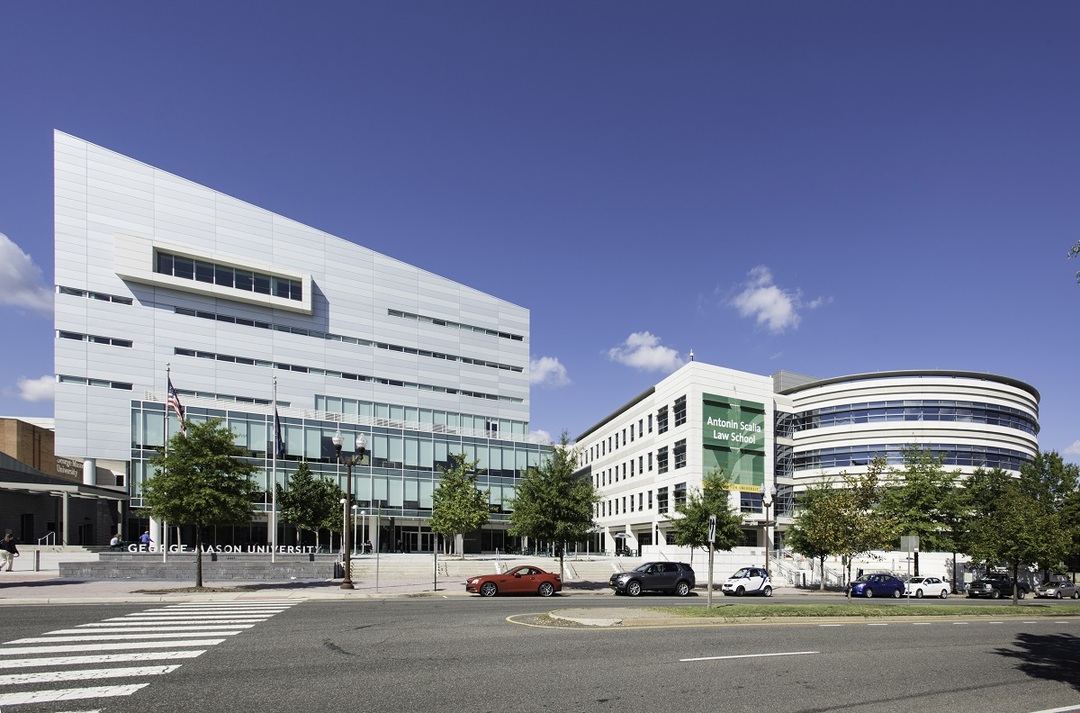
    <summary type="html"><![CDATA[<p><strong><em>Mason’s Arlington campus, Mason Square, came to be through of the resolution of two distinct challenges: the university’s desire to have a law school, and a small local law school’s difficulties in attaining accreditation. </em></strong></p><img src="https://pastandpresent.gmu.edu/files/fullsize/16b7d5caec5f888a7a6ef2e77d6a1d61.jpg" alt="The Arlington Campus" /><br/><p>In 1978, the George Mason University Foundation purchased eleven acres of land and the former Kann’s department store building in the Virginia Square neighborhood in Arlington. After Kann’s closed in 1975, the <a href="https://masonlibraries.org/masonhistory/exhibits/show/prominence/isl">International School of Law (ISL)</a> purchased the building in anticipation that the area’s projected growth would attract more students. However, the reality was that for ISL to stay open, they needed American Bar Association accreditation, which remained elusive.
Coincidentally, George Mason University wanted a law school and believed the Northern Virginia region needed one. Unfortunately, the Association of American Law Schools, the State Council of Higher Education for Virginia (SCHEV) and the General Assembly rejected Mason's request to establish a law school, twice. In 1976, the Honorable Charles S. Russell, a judge for the Seventeenth Judicial Circuit and, later, the Supreme Court of Virginia, became aware that Mason’s Board of Visitors hoped to add a law school to grow the university. Russell knew that ISL and Mason were seeking partnerships to resolve their respective law school difficulties. So, Russell arranged a secret meeting between ISL Dean, Ralph Norvell and the Rector of Mason’s Board of Visitors, John “Til” Hazel, at a restaurant across the street from ISL. As they ate lunch, the two men agreed that a merger would be advantageous to each of their respective institutions. Hazel and Norvell shook hands and decided to work together for Mason’s and ISL’s mutual benefit. But first, they needed both SCHEV and the General Assembly to approve the merger.
Unfortunately, Mason and ISL also faced opposition to their merger. In November 1978, Mason purchased ISL’s property in Arlington for $3.2 million. In response to this gutsy move, SCHEV issued an additional report to the General Assembly, again showing resistance to the merger. To ensure Mason’s attempt to acquire a law school would succeed, Hazel created the “Urge to Merge” lobbying campaign to convince Virginia’s legislature to approve the merger. Motivated by the prospect of accredited degrees and a chance to sit for the bar exam, law school students worked with Hazel on the campaign. Their efforts were rewarded in February 1979 when the State Senate and House of Delegates passed Senate Bill 607, authorizing <a href="https://masonlibraries.org/masonhistory/exhibits/show/prominence/schooloflaw">the merger between George Mason University and ISL</a>. Mason finally had a law school, and ISL students received accredited degrees that spring.
The former department store building, built in 1953, became Mason’s first building on the new Metro Campus, its name before it was renamed <a href="https://masonlibraries.org/masonhistory/exhibits/show/prominence/arlington">Arlington Campus</a> in 1989. The building was known as "Original" or "Arlington Original". The building had escalators and a PA system from its time as a department store, making it the only law school building with an escalator at the time of the merger. Law school students recalled using the PA system to request assistance from facilities staff. Original's huge footprint allowed Mason to expand its programs, eventually filling up the law school building. As Mason’s enrollment in Arlington increased, the university leased space in neighboring buildings, such as one at Quincy Street Station, eight blocks to the south. However, this solution could still not sustain Mason’s rapid growth in Arlington.
By 1988, GMU President George Johnson had plans to grow the Arlington Campus and make the Virginia Square neighborhood “an educating community.” As a result, Mason drafted expansion plans that included multiple phases of construction. The first phase provided a modern building, Arlington I, for the law school and its library on the land that used to be Original’s parking lot. Arlington I’s construction broke ground on April 25, 1996, and cost approximately $19 million. This new building opened in 1998 and dedicated in January 1999. Arlington I became the new home of the law school, its library, the Mercatus Center and the Institute for Humane Studies. As a result, programs in the leased Quincy Street Station location moved into Original. The second expansion on the Arlington campus was completed shortly afterward. It included a 240,000-square-foot building and public plaza between Arlington I and Original. This building housed a library, an art gallery, and a large auditorium. The Metropolitan Building, located between the Law School and FDIC headquarters, opened in 2006 and houses a parking garage and office space. Construction on Arlington II finished in 2011. This building became home to the then-named School of Public Policy and was known as Founders Hall.
In 2005, Arlington I was renamed John T. Hazel, Jr. Hall (Hazel Hall) in recognition of the role Rector Hazel played in establishing Mason’s law school. Hazel Hall is home to Antonin Scalia Law School, renamed after the late Supreme Court Justice in 2016. In June 2017, the Foundation Building was renamed Vernon Smith Hall in honor of Mason’s second Nobel Prize winner. Vernon Smith Hall is home to the Jimmy and Rosalynn Carter School for Peace and Conflict Resolution. Founders Hall was renamed Van Metre Hall in October 2018 in recognition of a previous donation of land by Van Metre Companies, a local commercial and residential real estate firm. Van Metre Hall is home to the Schar School of Policy and Government, named for benefactor, Dwight Schar. Finally, in 2020, Original was demolished to make way for a new building, Fuse, which will focus on technological innovation and entrepreneurship.
The Arlington Campus became known as Mason Square in 2022. Mason Square predominantly offers evening classes, and the campus comes alive around 4 p.m. Its plaza has become an energetic center for campus and community engagement. It has featured a game cart, a ping pong table, and a cornhole set for use by the local community. Free yoga classes and juggling lessons have been offered in the plaza, and musicians play cheerful music in the plaza regularly. The plaza also hosts outdoor concerts and movie screenings. Mason Square is located across the street from the original El Pollo Rico restaurant, a beloved hangout spot. In addition, Mason Exhibitions Arlington is two blocks from the campus on Fairfax Drive. Construction on Fuse is expected to be completed in 2025.
 </p><p><em><strong><a href="https://pastandpresent.gmu.edu/items/show/20">For more (including 8 images&#32;&amp;&#32;1 video) view the original article</a></strong></em></p>]]></summary>
    <published>2023-05-01T19:07:41+00:00</published>
    <updated>2026-04-17T19:45:24+00:00</updated>
    <link rel="alternate" type="text/html" href="https://pastandpresent.gmu.edu/items/show/20"/>
    <id>https://pastandpresent.gmu.edu/items/show/20</id>
    <author>
      <name>George Mason University Past and Present Team</name>
    </author>
  </entry>
  <entry>
    <title type="html"><![CDATA[The Lecture Hall: Mason&#039;s &quot;Mysterious&quot; First Gathering Place]]></title>
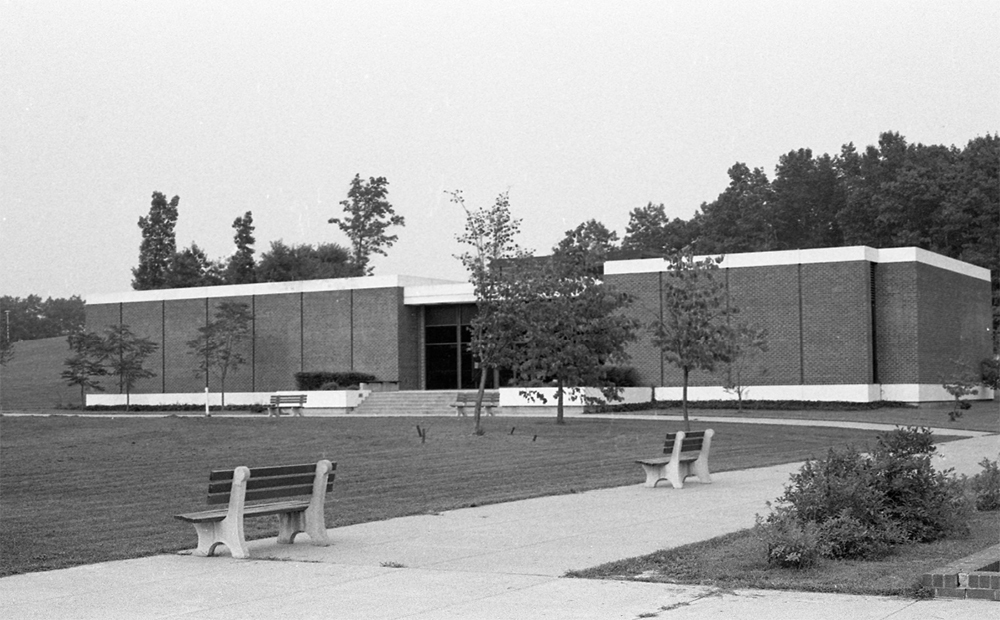
    <summary type="html"><![CDATA[<p><strong><em>The small nondescript structure on George Mason's Fairfax Campus' northeast side has been a witness to and contributor to university history. The building has been the host of Mason's first Commencement, performing arts productions, and quite a few other gatherings, not to mention tens of thousands of class lectures. But was this building actually meant to be built on the Fairfax Campus?</em></strong></p><img src="https://pastandpresent.gmu.edu/files/fullsize/8e45d80c8284b777797f012d622c5de8.jpg" alt="Lecture Hall, view from the southwest" /><br/><p>There is a legend among long-time faculty and staff at George Mason that the Lecture Hall on the Fairfax Campus was intended for another university in the commonwealth. Indeed, the author of this piece has been told by more than one long-tenured Mason employee that our Lecture Hall was meant to be built elsewhere. Believers in the legend point to the fact that the Lecture Hall does not resemble the initial buildings constructed at Fairfax just three years earlier. It is true that the Lecture Hall was initially scheduled to be completed in 1964, and it was meant to resemble the North, South, East and West Buildings in many respects, but budget overruns forced the Lecture Hall to be eliminated from the initial construction. </p><p>In 1965 the University of Virginia (Mason's then parent institution) successfully petitioned the General Assembly for funding to add this missing piece to compliment the Library that was already underway. As with the original four buildings, the University chose a local architect to design the Lecture Hall. The firm, Vosbeck and Vosbeck of Alexandria was the same which designed Fenwick Library, but, interestingly, not the same which designed the original four buildings (Saunders and Pearson - also of Alexandria). Construction began in Spring of 1966 and was complete in December of 1967. The Lecture Hall had three auditoriums, one large one seating three hundred and two smaller ones, each seating one hundred. </p><p>By the spring semester of 1968, the Lecture Hall was busy around the clock hosting classes and other noteworthy events. In February, there was a controversial and well-attended program where faculty members debated whether colleges should eliminate the grading system. In March, Mason's Agora Society presented Shakespeare's <em>The Country Wife</em>. Tickets sold for $1.00 each. In April and May, Philosophy professor Dr. James Shea appeared in several Vietnam War-related teach-ins in the Lecture Hall. And on June 9, it hosted Mason's first Commencement. The college initially planned to confer degrees on the fifty-two members of Mason's Class of 1968 outdoors on the lawn in front of the Lecture Hall, but rain was in the forecast for that day, forcing the ceremony indoors. </p><p>The Lecture Hall was the venue for another notable gathering in 1974. On February 11 peace activists Jane Fonda, her husband, founder of Students for a Democratic Society, Tom Hayden, and folk singer Holly Near visited George Mason University as part of the Indochina Peace Initiative tour. It was attended by about one hundred George Mason students, faculty, and staff, some of whom, it has been rumored, were FBI agents disguised as students.</p><p>In the early 2000's the Lecture Hall was among several buildings on the north side of campus set to be demolished for the creation of a global education complex. This never came to fruition, and it has remained a part of the Fairfax Campus. </p><p>The Lecture Hall has played a key part in the function of the university ever since it first opened over fifty-six years ago. Simple but unique among the other places on the Fairfax Campus, it has had and continues to play a small yet significant role at Mason.</p><p><em><strong><a href="https://pastandpresent.gmu.edu/items/show/6">For more (including 8 images) view the original article</a></strong></em></p>]]></summary>
    <published>2022-12-12T21:25:36+00:00</published>
    <updated>2026-04-17T19:45:23+00:00</updated>
    <link rel="alternate" type="text/html" href="https://pastandpresent.gmu.edu/items/show/6"/>
    <id>https://pastandpresent.gmu.edu/items/show/6</id>
    <author>
      <name>George Mason University Past and Present Team</name>
    </author>
  </entry>
  <entry>
    <title type="html"><![CDATA[Fenwick Library: Serving George Mason University Since 1967]]></title>
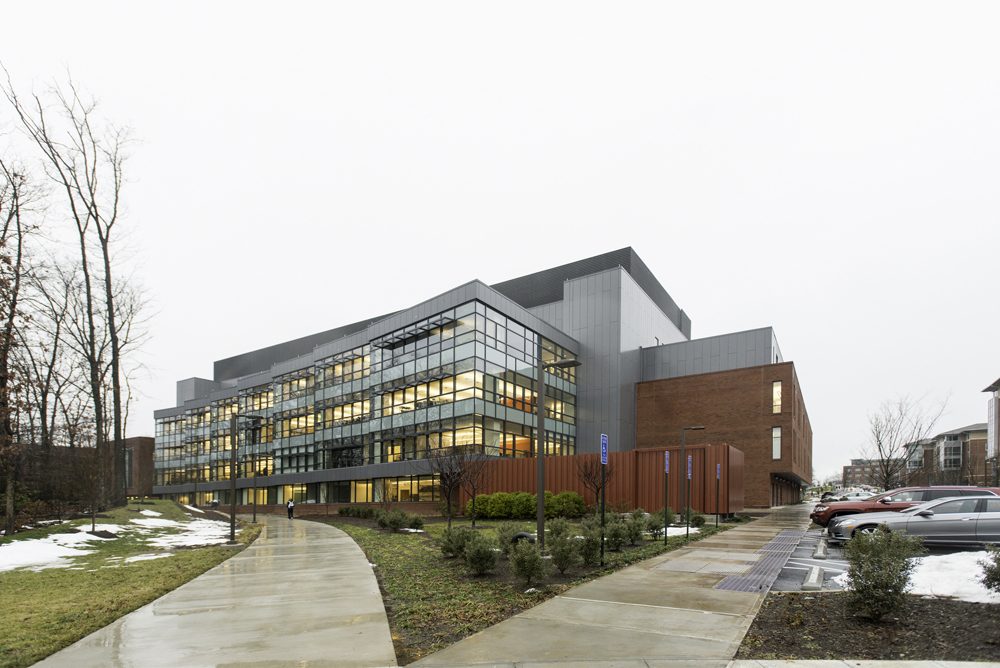
    <summary type="html"><![CDATA[<p><strong><em>Completed in October 1967 Fenwick Library has occupied the same spot for over 56 years. While it has undergone many changes over the years, its mission to facilitate access to scholarship and information and teach the effective and critical use of information remains the same. </em></strong></p><img src="https://pastandpresent.gmu.edu/files/fullsize/041022fd2a911150eb2fd26684361054.jpg" alt="Fenwick Library, view from the southeast" /><br/><p>George Mason University Libraries began operation in September 1957 at Bailey's Crossroads Campus, occupying three of the four rooms on the upper level of the building. As the number of library resources increased, librarians, who moonlighted at Bailey's while employed at other local libraries, stored newly acquired resources in closets and bookcases sitting in hallways.  </p><p>When the college moved into the new campus at Fairfax in 1964, a permanent college librarian was hired by the University. Patrick Joseph Larkin, a recent graduate of the Master of Library Science at nearby Catholic University was chosen to head up the new Library. Initially, the Library was located on the 2nd Floor of the new Fairfax Campus' East Building.  During this time planning for Mason’s permanent stand-alone library at Fairfax was gearing up with Larkin and officials from George Mason College and the University of Virginia actively participating in the design and functionality groundwork. </p><p>Mason's permanent Library was designed for a “commuter college” with specific needs: a large commuting student body, an evolving program of studies, and a rapid growth rate.  Mason had less than 1,000 students during the late-1960s, but more than twice that many after only five years. In 1966 a report of the Northern Virginia Regional Planning and Economic Development Council estimated that by 1985, 15,000 high school graduates would be knocking on Mason’s doors. </p><p>The architectural firm Vosbeck-Vosbeck & Associates of Alexandria designed a two-story white concrete-columned structure with alternating brick panels. The building contained 31,500 square feet, housed up to 60,000 book volumes, and seated almost 500 readers.  Construction began in July 1966 at a cost of $1.2 million (a little more than $10 million in 2023).          </p><p>The library took about fifteen months to complete. By the third week in October 1967, it was ready for use. On move-in day library staff, along with dozens of volunteers from the student body, carted some twenty thousand volumes from the East Building to the new library to be shelved.  The building was formally dedicated on December 15, 1967, in an hour-long ceremony which was concluded with an announcement that it would be named Fenwick Library, after State Senator Charles Rogers Fenwick, a longtime political ally of George Mason College. </p><p>By 1974 enrollment at George Mason, now a university, had increased by more than 500% since 1967. Library space expanded to keep up with the demands of a growing university.  This came in the form of two adjoining towers, one completed in 1974, and the other in 1983. The towers now known as Wings B and C increased the library’s storage space by twelve times. During the late 1980s there were plans to increase library space once again, but these plans were scrapped to design and build the facility now known as the Johnson Center.  Beginning in the 1980s, the stage for Mason Day band performances was placed on the plaza in front of the Fenwick Library entrance and for nearly twenty years, the sounds of live music would permeate the library on that day. </p><p>Beginning in September 2012 Fenwick Library underwent a four-year transformation to bring it up to par with other major university libraries in the commonwealth. This addition, which opened in 2016, wrapped the existing Wing B and C towers and doubled the library’s space, enabling the university to meet growing needs for a variety of study and research spaces.</p><p><em><strong><a href="https://pastandpresent.gmu.edu/items/show/5">For more (including 7 images) view the original article</a></strong></em></p>]]></summary>
    <published>2022-10-20T20:48:43+00:00</published>
    <updated>2026-04-17T19:45:23+00:00</updated>
    <link rel="alternate" type="text/html" href="https://pastandpresent.gmu.edu/items/show/5"/>
    <id>https://pastandpresent.gmu.edu/items/show/5</id>
    <author>
      <name>George Mason University Past and Present Team</name>
    </author>
  </entry>
  <entry>
    <title type="html"><![CDATA[The Bailey&#039;s Crossroads Campus: George Mason University&#039;s Humble Beginnings]]></title>
    <summary type="html"><![CDATA[<p><strong><em>After being approved for operation by the Virginia General Legislature in 1956, the institution that became George Mason University began in an old elementary school building at the intersection of Columbia and Leesburg Pikes in the Bailey's Crossroads section of eastern Fairfax County in the fall of 1957. </em></strong></p><img src="https://pastandpresent.gmu.edu/files/fullsize/6efec2b482850e1aecfa7e8223b2ddb6.jpg" alt="George Mason College, Bailey&#039;s Crossroads Campus" /><br/><p>The former Bailey’s Elementary School located at 5836 Columbia Pike was a small well-used eight-room red-brick schoolhouse built in 1922. “Old Bailey’s” was abandoned in 1954 for a new one nearby.  The University of Virginia leased the building from Fairfax County Public Schools for $600.00 per year, moved into the building in the summer of 1957, and began classes that September with seventeen students. John Norville Gibson Finley, formerly an English professor from the campus at Charlottesville was named the college's director. </p><p>The lower level had four classrooms (two science labs and two lecture rooms). Up the creaky staircase from the mail entrance were three rooms that comprised the library and one classroom. </p><p>Because all spaces in the building were in use at all times, there was no place for students to socialize before and after class. To help remedy this, the Bailey’s Crossroads Volunteer Fire Department next door kindly allowed students at the college to use the station’s upstairs break room and bingo hall as a lounge. </p><p>Space for other collegiate activities was always at a premium. There was no room that could house more than 30 people comfortably. As a result, functions such as assemblies, meetings, dances, and Final Day Exercises (since there were no terminal degree programs at the branch “Final Day Exercises” were the equivalent of commencement) were held at locations nearby, such as the Bailey’s Crossroads Fire Department, the Alexandria Episcopal Seminary, and local hotels and churches. Athletic events, which were never more than a pick-up or faculty vs. student game, took place either on the dirt field adjacent to the building which doubled as overflow parking or on the fields of local schools, such as Glen Forest Elementary School, which was located one-half mile to the northwest.</p><p>Bailey’s served as the primary location for the University College (which would later be renamed George Mason College in January 1960) from September 1957 until August 1964. Though conditions were challenging for the early pioneers at Bailey’s Crossroads, the students, staff, and the local population became fond of their school, and some were even sad to have to leave. </p><p>The staying power of Bailey’s (or BXU as some Mason students affectionately called it) is a testament to the commitment of the people of Northern Virginia toward higher education. Individuals from all backgrounds and parts of the area labored to make certain that Bailey’s would make a go of it until more permanent quarters were available. This was finally realized on August 27, 1964, when the last of the moving vans left Bailey’s with equipment and furniture bound for the brand-new permanent campus just south of Fairfax.</p><p><em><strong><a href="https://pastandpresent.gmu.edu/items/show/3">For more (including 8 images) view the original article</a></strong></em></p>]]></summary>
    <published>2022-10-12T19:42:52+00:00</published>
    <updated>2026-04-17T19:45:23+00:00</updated>
    <link rel="alternate" type="text/html" href="https://pastandpresent.gmu.edu/items/show/3"/>
    <id>https://pastandpresent.gmu.edu/items/show/3</id>
    <author>
      <name>George Mason University Past and Present Team</name>
    </author>
  </entry>
</feed>