<?xml version="1.0" encoding="UTF-8"?>
<feed xmlns="http://www.w3.org/2005/Atom">
  <title type="text">The Mason Experience: Past and Present</title>
  <updated>2026-09-05T05:10:29+00:00</updated>
  <generator uri="http://framework.zend.com" version="1.12.20">Zend_Feed_Writer</generator>
  <link rel="alternate" type="text/html" href="https://pastandpresent.gmu.edu/"/>
  <link rel="self" type="application/atom+xml" href="https://pastandpresent.gmu.edu/items/browse?output=rss2"/>
  <id>https://pastandpresent.gmu.edu/</id>
  <author>
    <name>The Mason Experience: Past and Present</name>
    <uri>https://pastandpresent.gmu.edu</uri>
  </author>
  <link rel="hub" href="http://pubsubhubbub.appspot.com/"/>
  <entry>
    <title type="html"><![CDATA[The Clock: A Legacy of the Class of 1999]]></title>
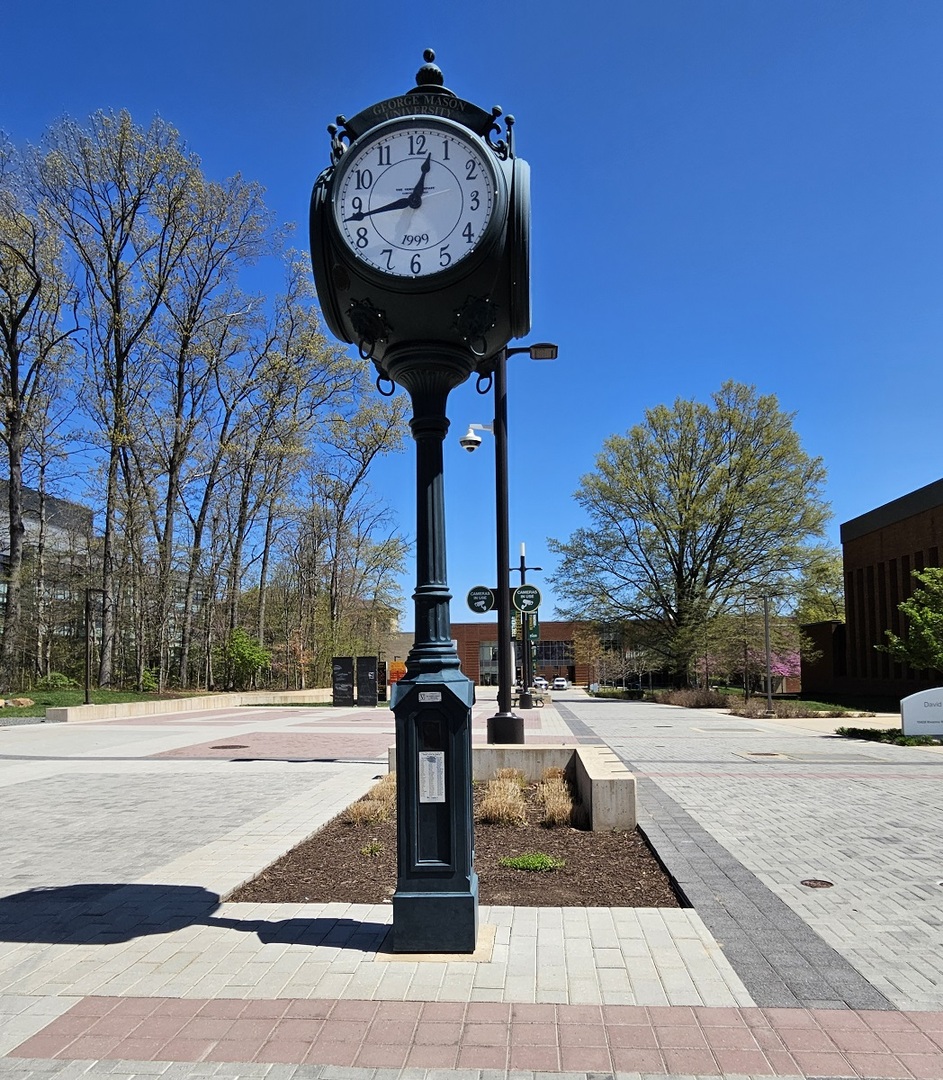
    <summary type="html"><![CDATA[<p><strong><em>One of the most iconic landmarks on campus is also one of its most mysterious.</em></strong></p><img src="https://pastandpresent.gmu.edu/files/fullsize/b579987cc5c23016e077f98cbfd687f4.jpg" alt="The Clock on Wilkins Plaza" /><br/><p>The Clock stands on Wilkins Plaza at the intersection of the Johnson Center, Horizon Hall, Fenwick Library, and David King Hall. The number "1999" appears on the clock’s face, as it was a gift to the university from Mason's Class of 1999. Its estimated cost, according to the only <em>Broadside</em> article written about the Clock from September 20, 1999, was $15,000.</p><p>The establishment of the Clock as a physical part of the Fairfax Campus began as a project led by John Butler, Student Government President, from 1998-1999. Butler wanted the Student Government and graduating class of that year to give back to the university and leave a lasting legacy. The plaque on the clock’s base lists the names of 113 students from the Class of 1999 who contributed toward the purchase of the clock. According to some members of the Class of 1999, they did not recall hearing about the clock and thought it suddenly appeared one day. Jimmie Foster, Jr., a <em>Broadside</em> photographer, took the earliest known photographs of the clock on May 1, 1999.</p><p>In December 2018, the clock was removed and stored in a warehouse to allow for the expansion of Wilkins Plaza as part of the Core Campus Project. While the clock was away, its manufacturer, Verdin, fully refurbished it. Students previously noticed that the clock’s time was a few minutes off. The clock now has digital controls that eliminate the need for it to be manually programmed and ensure that it displays the correct time automatically. Verdin also thoroughly cleaned the clock and gave it new scratch-resistant lenses. The clock was reinstalled on Wilkins Plaza in December 2020. </p><p>Today, the clock remains an important landmark and gathering place for students due to its central location on the Fairfax campus. Students conduct club activities like fundraisers and recruitment near the clock, where they can catch the attention of students leaving the Johnson Center and Fenwick Library. In addition, the clock serves as a meeting point for protests and emergency evacuations. Finally, it has become a tradition for graduating students to take photos with the clock.</p><p><em><strong><a href="https://pastandpresent.gmu.edu/items/show/18">For more (including 9 images) view the original article</a></strong></em></p>]]></summary>
    <published>2023-04-05T14:40:55+00:00</published>
    <updated>2026-04-17T19:45:24+00:00</updated>
    <link rel="alternate" type="text/html" href="https://pastandpresent.gmu.edu/items/show/18"/>
    <id>https://pastandpresent.gmu.edu/items/show/18</id>
    <author>
      <name>George Mason University Past and Present Team</name>
    </author>
  </entry>
  <entry>
    <title type="html"><![CDATA[George Mason Statue: Mason&#039;s Beloved Landmark]]></title>
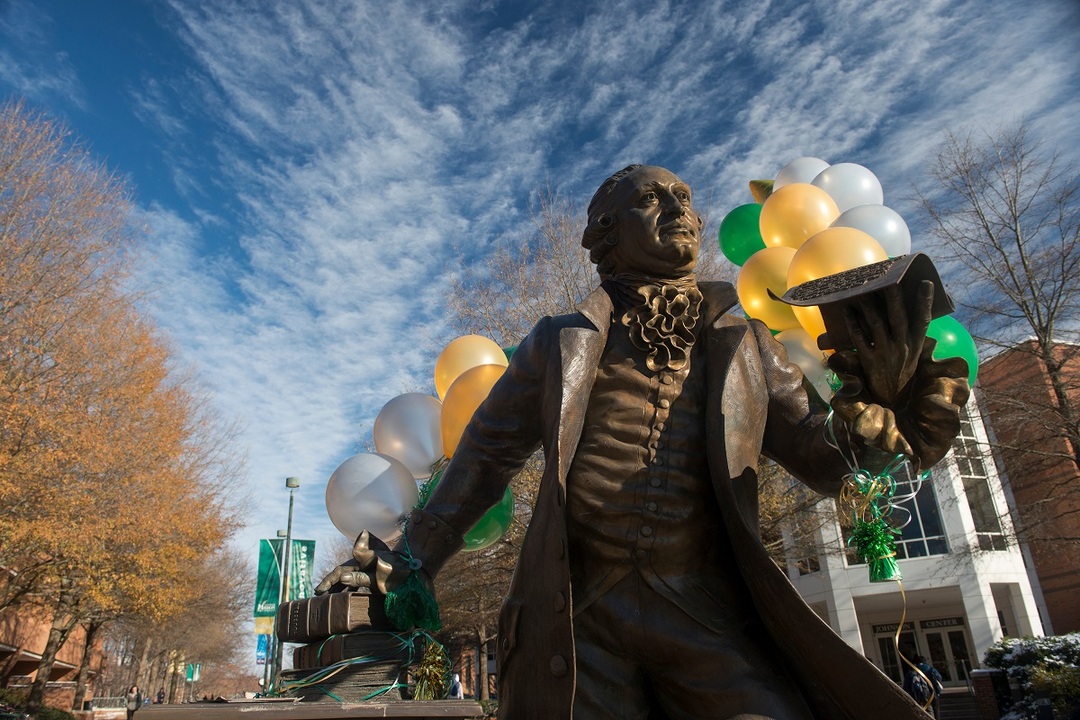
    <summary type="html"><![CDATA[<p><strong><em>Although the decision to name the University after George Mason came in 1959, the idea for a statue of him on campus was not proposed until thirty years later, in 1989. Like many celebrated traditions at Mason, the George Mason Statue started as a student initiative.</em></strong></p><img src="https://pastandpresent.gmu.edu/files/fullsize/abf8766b226d2faffb8787fb1d59660b.jpg" alt="George Mason statue" /><br/><p>George Mason (1725-1792) a Fairfax, Virginia planter authored the Virginia Declaration of Rights and the Virginia Bill of Rights and Constitution, on which the United States Bill of Rights is based.  A member of the original Constitutional Convention, Mason refused to sign the initial draft of the Constitution because it did not include a Bill of Rights. </p><p>In 1959 the president of The University of Virginia, Colgate W. Darden, Jr, suggested that a new name be chosen for its branch college at Bailey's Crossroads. Three names were offered to faculty, staff, and students for their consideration: "University College" (the name it had been using since its inception in 1957), "Northern Virginia College", and "George Mason College". The voting ended in a virtual three-way tie, and the University's Board of Visitors broke the tie by choosing "George Mason" at its December meeting that year.   </p><p>In the late 1980s, the Student Government pointed up that GMU needed new ideas and traditions to boost school spirit and a sense of community. In February 1989 it publicly proposed erecting a statue of the school’s namesake on the quad to foster campus pride, unity and tradition. They estimated that the statue would cost between $30,000 and $50,000 and hoped that donations from student organizations would cover the costs over a five-year period. Although they made this announcement in 1989, students privately proposed the statue 2 years earlier, according to the official dedication program. Unfortunately, college students are generally not in a financial position to donate, the Student Government’s fundraising campaign was unsuccessful.</p><p>In 1992, the Student Government asked for assistance from Mason administrators. The Offices of the Provost and Student Affairs sponsored a competition for a nationally renowned sculptor to design the George Mason statue. It is challenging for artists to depict George Mason. The only surviving portrait of Mason shows him in his thirties and was painted nearly 20 years after his death. Out of four finalists, the students comprising the George Mason Statue Committee selected the 18-inch clay model made by Wendy M. Ross.</p><p>Ross studied at the University of Wisconsin and the San Francisco Art Institute and later received a Master of Fine Arts from the Rhode Island School of Design. She currently maintains studios in Bethesda, Maryland, and Oregon. Ross has enjoyed a decades-long career and created sculptures for the U.S. Supreme Court, U.S. Capitol, and National Park Service. Her concept for the George Mason statue shows him presenting his first draft of the Virginia Declaration of Rights in 1776. She visited Mason’s home, Gunston Hall to do research, and the writing table in the sculpture replicates the one in his study. The books on the table are by John Locke, David Hume, and Jean-Jacques Rousseau. This selection of authors reflects Mason’s philosophical influences regarding ideas of personal liberty. Ross was also selected as the sculptor for the George Mason memorial on the National Mall, dedicated on April 9, 2002.</p><p>After attempts to secure public funds failed, the Arts Gala Committee, led by Joanne Johnson, commissioned the sculpture on August 1, 1995. They contributed $148,500, 93% of its $159,000 cost and presented the George Mason sculpture as a gift to the GMU community. The 10-foot-tall bronze statue was formally dedicated along with the Johnson Center on April 12, 1996. It was the first 3-D depiction of George Mason in United States history. The statue is located on the southern end of Wilkins Plaza and can be found between the Johnson Center and the Harris Theatre. </p><p>As the students envisioned, the George Mason statue has become a beloved landmark on campus with traditions and superstitions attached to it. It is a tradition for graduating students to get a photo with George. Student groups dress George up for festive occasions and milestones, like graduation and sporting events. He also dons t-shirts and holds signs to participate in student advocacy. Ross stated in interviews that she loves when students dress up the statue and how iconic it has become on campus. In addition, there are superstitions attached to the statue, bringing both good and bad luck. Students rub George’s left toe for good luck before important exams or papers. GMU legends say stepping on the plaques around the statue brings bad luck. If a current student does this, they will not graduate in four years, and a prospective student who does so will not be admitted to Mason.</p><p><em><strong><a href="https://pastandpresent.gmu.edu/items/show/16">For more (including 10 images) view the original article</a></strong></em></p>]]></summary>
    <published>2023-03-22T19:49:59+00:00</published>
    <updated>2026-04-17T19:45:23+00:00</updated>
    <link rel="alternate" type="text/html" href="https://pastandpresent.gmu.edu/items/show/16"/>
    <id>https://pastandpresent.gmu.edu/items/show/16</id>
    <author>
      <name>George Mason University Past and Present Team</name>
    </author>
  </entry>
  <entry>
    <title type="html"><![CDATA[SUB I: Student Union Building I, Mason&#039;s First Student Center]]></title>
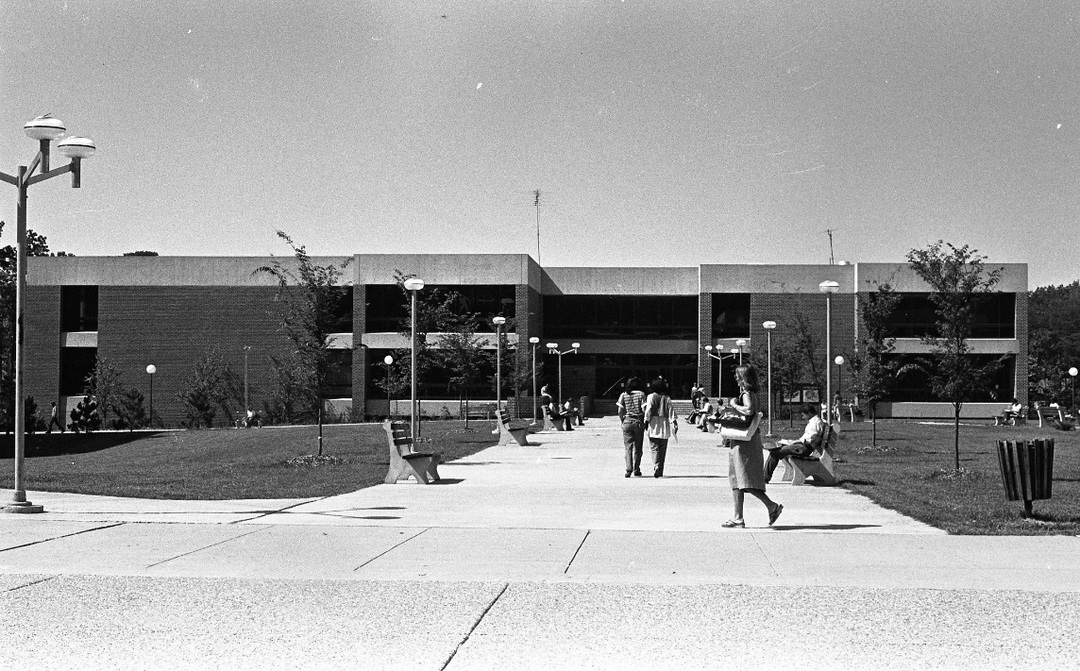
    <summary type="html"><![CDATA[<p><strong><em>Students today know SUB I as the place where their student ID cards are issued and where they can grab a Chick-Fil-A sandwich. However, when it opened in 1974, it was first building of its kind on campus and the place to be. The Student Union Building was the first building at Mason conceived entirely with students in mind. It provided dedicated spaces for student clubs, government, media , leisure activities and services.</em></strong></p><img src="https://pastandpresent.gmu.edu/files/fullsize/b891262726ba6151be9c0b28b4353bf7.jpg" alt="Students in the plaza in front of the Student Union Building" /><br/><p>The original Student Union Building (today known as Student Union I or, simply, SUB I) was announced in January 1968 and was the first building at Mason intended to be entirely for student use. It provided dedicated space for student dining, student clubs, student government, student publications, and other student activities. Unfortunately, the building project was delayed for four years, due to difficulties gaining budget approval in the Virginia Legislature. Phase I of the Student Union Building’s construction broke ground on March 1, 1972. The building’s cost was estimated at $1.9 million at the time (about $9 million in 2023). However, upon completion, the Student Union's operating costs were to be supported predominantly by student fees. To achieve this, President Lorin Thompson added a "building fee" to tuition fees in 1973. By 1974, the Student Union was 97% student funded.</p><p>Because students funded the Student Union, they expected that the building would be entirely for student use, and that they would be engaged in decisions regarding its operation. However, the Board of Visitors and new Mason President Vergil Dykstra’s administration had its own plans for the building’s use and students’ inclusion in its governance, leading to conflicts and controversies before and after opening. For example, the Board of Visitors hired the Student Union's director without considering students’ input, although they had participated in the interview process. In addition, they relocated administrative offices for student services to the Student Union and opened its student-only dining room to faculty. Furthermore, the Board of Visitors unilaterally changed the building’s name from Student Union to University Union. Their decisions prompted backlash from students who felt they  were funding the building with the understanding that it was for them.</p><p>When Phase I opened on February 1, 1974, it housed the offices of Career Planning, Financial Aid and Placement, Campus Ministry, Honor Committee, Student Government, and the University Union Director. The 40,000 square foot space also included meeting rooms, study lounges, spaces for student clubs and activities, a game room, a bookstore, a cafeteria, a card room, a television room, a music room, telephones, and an information desk. In addition to the amenities advertised by Mason’s administration, the Student Government ran a coffee house program in the building that featured live poetry and music on Fridays. The Student Union replaced the Ordinary and provided students with a permanent hangout spot. By the end of the school year in 1974, the Broadside noted that the building “glowed with activity” late into the evening.</p><p>Although students were grateful for the building, resentments simmered over the lack of communication from Mason’s administration. After the building opened, students voted to change its name back to the Student Union, and the presence of administrative offices in the building remained unpopular. Tensions over space in the Student Union reached a breaking point in the fall of 1974. Students found out that the administration planned to relocate the Campus Ministry to use its office for a newly hired scholarship placement assistant. As a result, the Student Government circulated a petition against the relocation of the Campus Ministry. Those who signed the petition said they were signing for students’ rights to give input in decisions regarding the Student Union Building. Within two weeks, the petition had five hundred signatures from students, faculty, staff and administrators. The three-week controversy between Mason students and administration regarding autonomy over the Student Union Building concluded when President Dykstra canceled the Campus Ministry’s move and gave the new staff member a smaller space until the completion of Phase II’s construction.
Construction on Phase II of the Student Union Building I began on January 1, 1974. It opened partially in May 1975 and completely in the summer of 1975. Phase II added 40,000 square feet to the building, doubling its size. Existing student clubs, fraternities, and student services received expanded space. Phase II added new amenities like a clinic, a counseling center, an arts and crafts center, a bank, dry cleaning, and a pub. The <a href="https://vault217.gmu.edu/?p=8527">Rathskeller</a>, Mason’s first and only student pub, operated in the Student Union from 1975 to 2019.</p><p>Phase III, which added to the back of the building, was completed in 2011. This additional space allowed the Registrar’s Office to move from the Chesapeake Module behind Fenwick Library into the Student Union. Many amenities originally located in the original Student Union eventually moved to Student Union Building II (The Hub) or the Johnson Center, but it retains its student focus and many original services and amenities. Financial Aid, Career Services, Health Services and the Counseling Center are still in the original Student Union. The building’s stairways look the same as they did in 1975, retaining the original walls and floors and still functioning as a place to hang posters and advertisements. In addition to the aforementioned student services, students new to Mason or craving waffle fries visit the building for the Mason Card office and Chick-Fil-A.</p><p><em><strong><a href="https://pastandpresent.gmu.edu/items/show/7">For more (including 10 images) view the original article</a></strong></em></p>]]></summary>
    <published>2023-01-23T18:07:54+00:00</published>
    <updated>2026-04-17T19:45:23+00:00</updated>
    <link rel="alternate" type="text/html" href="https://pastandpresent.gmu.edu/items/show/7"/>
    <id>https://pastandpresent.gmu.edu/items/show/7</id>
    <author>
      <name>George Mason University Past and Present Team</name>
    </author>
  </entry>
  <entry>
    <title type="html"><![CDATA[The First Four Buildings at the Fairfax Campus: North, South,  East and West Buildings]]></title>
    <summary type="html"><![CDATA[<p><strong><em>The Fairfax campus opened in September 1964 with only four buildings. From then until 1974, these original buildings were the center of Mason student life and the site of many notable events.</em></strong></p><img src="https://pastandpresent.gmu.edu/files/fullsize/1b10b4e17a34adc477b0062f706460b4.jpg" alt="George Mason College, Fairfax Campus, ca. 1965, aerial photograph" /><br/><p>A groundbreaking ceremony for the new Fairfax campus was held on August 1, 1963. Students at Bailey’s Crossroads knew of the construction, but few were interested in following it. Student photographers Jim Wilson and Bill Flandermeyer visited the campus while it was under construction and took some of the earliest photographs of the Fairfax campus.
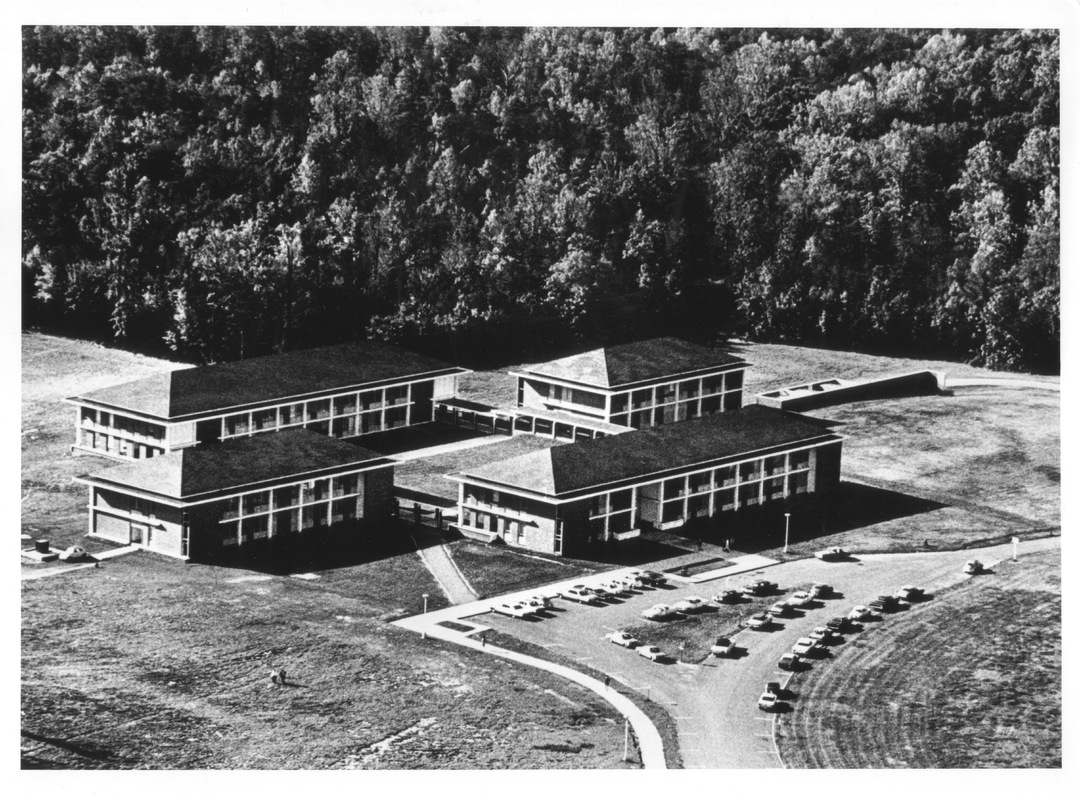
The campus at Fairfax officially opened on Monday, September 14, 1964, to 356 registered students. This number represented a 58% increase in the student population from the final school year at Bailey’s Crossroads. The original campus consisted of four buildings, named North, South, East and West, each for the direction it faced. Because the campus was initially small, students spent much of their campus life from 1964 to 1974 in these first four buildings. The then-state-of-the-art buildings were designed and built by local businesses Joseph Saunders & Associates of Alexandria and Eugene Simpson and brother, respectively.  
On opening day, Mason’s new director, Robert Reid, boasted to the Fairfax Times that Mason was the first fully air-conditioned college in the Washington, D.C., area. Air conditioning was a welcome change for students and faculty who experienced the lack of climate control in the old school building at Bailey’s Crossroads. They were delighted with the spacious, top-of-line classrooms and laboratories. The air conditioning and brand-new facilities temporarily distracted them from realizing the campus lacked some essential amenities. During the first week, there was no faculty lounge or place for students to get food and beverages. Mason’s administration quickly set up vending machines in a study hall as a temporary solution.
The campus was formally dedicated on November 12, 1964. The ninety-minute dedication ceremony took place in front of the North Building. Nearly a thousand people attended, including prominent politicians, educators, members of the community and the local press.
Construction was still ongoing when the Fairfax campus opened. The sidewalks were incomplete, so planks were put down when it rained. The covered walkways between the buildings had yet to be constructed. Former students described the campus as “a sea of mud.” Even with the wooden planks, mud was difficult to avoid since students had to cross an unpaved path between the North and East Buildings to reach their gravel parking lot. Photographs from the 1965 to 1966 yearbook show that in addition to the completion of sidewalks and covered walkways, the roads around campus and parking spaces were paved, finally ending the mud problem.</p><p><strong>South Building (Krug Hall)</strong>
By 1965, the students received a dining hall in the basement of the South Building. They named it the Ordinary, after the old English word for a pub. Chemical smells often drifted in from the biology and chemistry laboratories directly above. The Ordinary quickly became a popular hangout spot for students. Like their predecessors at the Bailey’s Crossroads campus, alumni from the Class of 1968 recalled playing competitive games of Hearts, Spades and Bridge. These card games were sometimes so intense that students nearly missed classes.
The Ordinary started serving fresh food in the fall of 1965. Articles <em>in The Gunston Ledger</em> frequently complained that the Ordinary was too crowded, so additional spaces for students to gather were added or improved in the East and West Buildings beginning in 1965. The Ordinary featured a jukebox. When the original jukebox died in April of 1966, a student penned an obituary for it in <em>The Gunston Ledger </em>commemorating its year and a half of service to students. <em>The Gunston Ledger</em> gleefully announced the purchase of a new jukebox for the Ordinary in October 1966. The Ordinary remained a gathering place for students until 1974 when the building that is now SUB I was completed.
Mason Day began in 1965 as a half-day of speeches and awards the day after UVA's Founder's Day celebration. During the 1968 to 1969 school year, Student Government Activities Chair, Mike Baker, transformed Mason Day into a multi-day spectacle of fun and entertainment. As part of Mason Day in 1969, for 3 days, 40 male students camped in tents behind the South Building. The event was labeled “Mason’s First Dormitories.” They ate their meals in the Ordinary, played sports on the lawn, roasted hot dogs, played music, watched movies and attended a presentation by local photographer Charles Baptie in the Lecture Hall, and staged a water balloon fight. Mason Tent City remained a tradition until 1977, when the university opened permanent dormitories.</p><p><strong>North Building (Finley Building)</strong>
The North Building originally housed Mason’s administrative offices. An anonymous article in <em>The Gunston Ledger</em>, on November 16, 1967, decried that Mason was the only institution in Virginia without a flagpole. The writer implored students to find a way to raise $150 for a flagpole. The shaming worked, and a flagpole, which no longer stands, was installed in front of the North Building shortly after.
According to <em>Broadside</em>, beginning November 10, 1969, students stood in front of the flagpole in a memorial vigil of the lives lost in the Vietnam War. The previous month, the Vietnam War Moratorium Committee had presented Chancellor Lorin Thompson with a petition containing hundreds of signatures from students and faculty asking to be excused for one day of classes to participate in anti-war activities. Thompson rejected their petition. The vigils in front of the flagpole, visible from the administrative offices, were likely a response to his denial of their request.
The Vietnam War Moratorium Committee had officially scheduled to attend an off-campus event on November 14, 1969. So students were shocked when a group of protestors, in a spectacle <em>Broadside</em> called "Guerrilla Theatre", burned an American flag in the Ordinary. That same afternoon, Professor James Shea led students in burning draft cards in the Quadrangle. The Guerrilla Theatre incident divided the Vietnam War Moratorium Committee's student leaders, with Jim Corrigan speaking out against it and George Whelpley behind it. The Student Government was similarly divided, voting 6-3-3 to oppose disciplinary action against those responsible for the incidents. The Student Government supported Shea and asked the administration to retain him.
On the morning of May 6, 1970, Mason students asked Thompson to lower the flag in honor of students killed by the National Guard at Kent State University two days earlier. Thompson denied their request. A Kent State student spoke in the Quadrangle. Following the speech, a demonstration of fifty Mason students marched to the flagpole in an attempt to lower the flag by cutting the cord used to raise and lower it. Campus police confronted the demonstrating students. At noon, Thompson agreed to lower the flag to half-mast to accommodate the students and prevent any unrest.</p><p><strong>East Building</strong>
The second floor of the East Building served as Mason's library until its free standing library was completed in late 1967. The entire East Building had originally been allotted for the library. However, the librarian generously gave two floors back to the college, which they used for classrooms and an additional lounge. In 1965, SAGE, a women’s organization on campus, hosted a fashion show in the East Building. On June 9, 1965, the first final day exercises were held in the East Building, and Mason’s class of 1965 received their diplomas. In 1968, the first class to graduate with Bachelor’s degrees from Mason put on their graduation robes in Eats before proceeding to the ceremony in the Lecture Hall.</p><p><strong>West Building</strong>
The West Building became the center of attention at Mason on September 21, 1966. At 2:10 pm that day, a hot water pump motor in the boiler room burned out and caused an electrical fire. The building’s supervisor discovered it but found his telephone was out of order. He then drove to the Fairfax Fire Station to report to the fire alarm. Seven fire trucks from Fairfax, Vienna, and Annandale responded to the fire alarm. The fire marshal ordered everyone to evacuate the smoke-filled West Building upon arrival. Firefighters set up fans to blow the smoke out of the building. Once it cleared, they put out the fire with a regular fire extinguisher. No one was injured, but students and staff were inconvenienced because the fire knocked out all telephone service and many of the lights across campus. The food machines in the Ordinary also did not work. Classes were dismissed for the rest of the day.</p><p><em><strong><a href="https://pastandpresent.gmu.edu/items/show/4">For more (including 13 images, 1 audio file,&#32;&amp;&#32;1 video) view the original article</a></strong></em></p>]]></summary>
    <published>2022-10-18T20:04:57+00:00</published>
    <updated>2026-04-17T19:45:23+00:00</updated>
    <link rel="alternate" type="text/html" href="https://pastandpresent.gmu.edu/items/show/4"/>
    <id>https://pastandpresent.gmu.edu/items/show/4</id>
    <author>
      <name>George Mason University Past and Present Team</name>
    </author>
  </entry>
</feed>